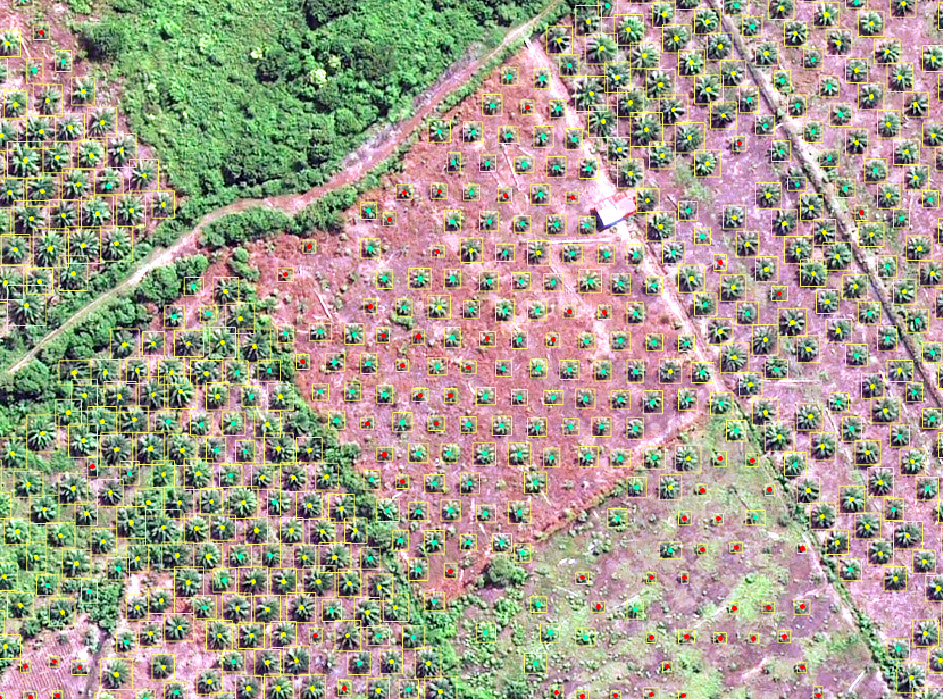
 Counting illegally planted oil palms in Rawa Singkil Wildlife Reserve. Imagery provided by @Airbus DS (July 2024) using Pléiades Neo satellites.
Imagery is available on Nusantara Atlas which is powered by TheTreeMap
Counting illegally planted oil palms in Rawa Singkil Wildlife Reserve. Imagery provided by @Airbus DS (July 2024) using Pléiades Neo satellites.
Imagery is available on Nusantara Atlas which is powered by TheTreeMap Counting Palms from Space: Measuring Illegal Oil Palm Production in Rawa Singkil
Counting illegally planted oil palms in Rawa Singkil Wildlife Reserve. Imagery provided by @Airbus DS (July 2024) using Pléiades Neo satellites.
Imagery is available on Nusantara Atlas which is powered by TheTreeMap
- Established in 1998, Rawa Singkil Wildlife Reserve is a globally recognized biodiversity hotspot within Aceh’s Leuser Ecosystem.
- Using an AI-based palm-counting approach and conservative assumptions, we produced the first estimate of illegal oil palm production and its economic value inside this reserve.
- As of July 2024, we detected 62,006 oil palm trees planted illegally within the Reserve.
- These palms produced an estimated 1,115 tonnes of crude palm oil (CPO) in 2024, equivalent to one week of milling for a palm oil mill operating at 45 tonnes of FFB per hour.
- At conservative farm-gate prices, this level of production corresponds to approximately Rp 12–17 billion (US$0.8–1.1 million) per year in gross revenue.
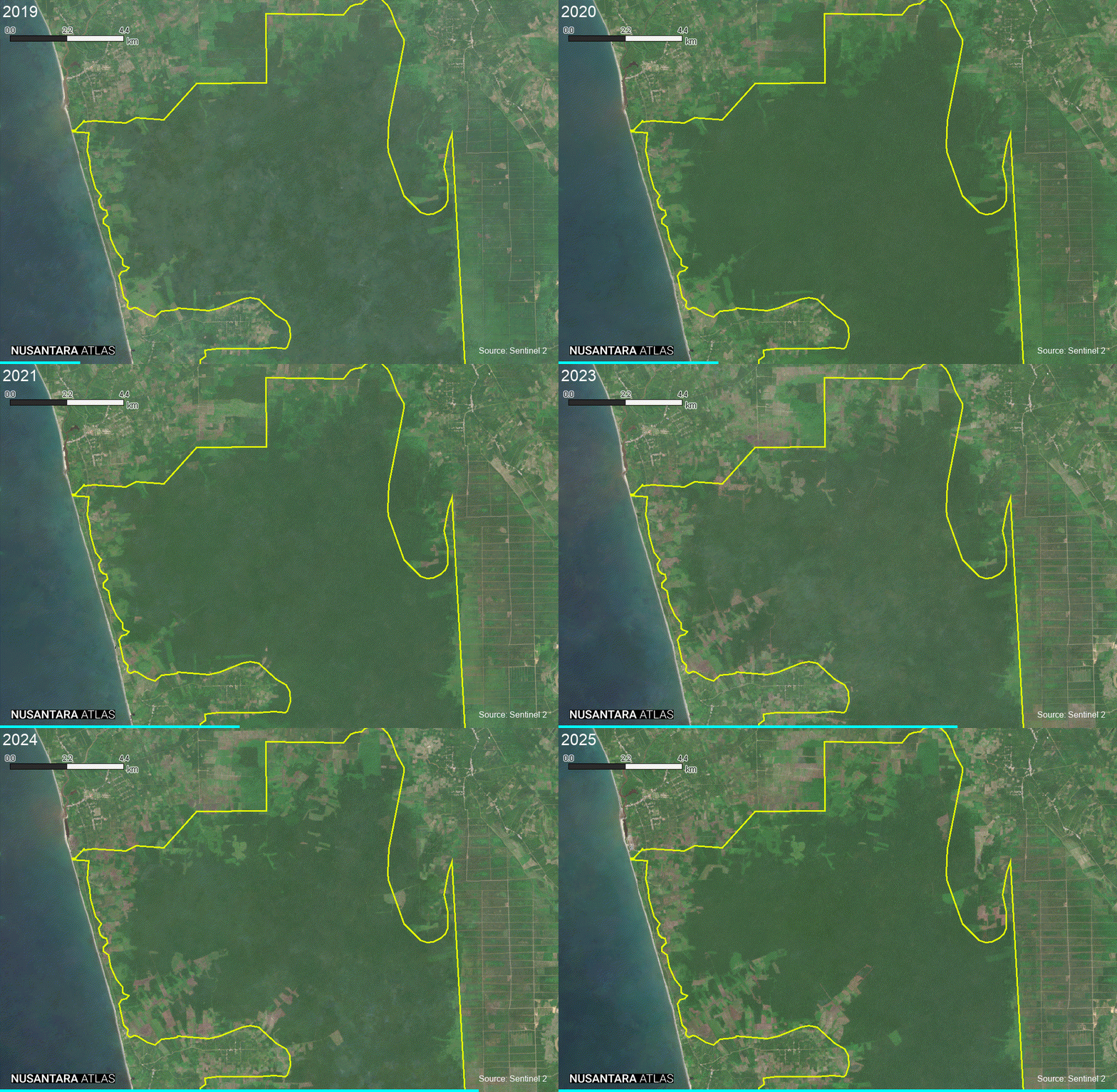
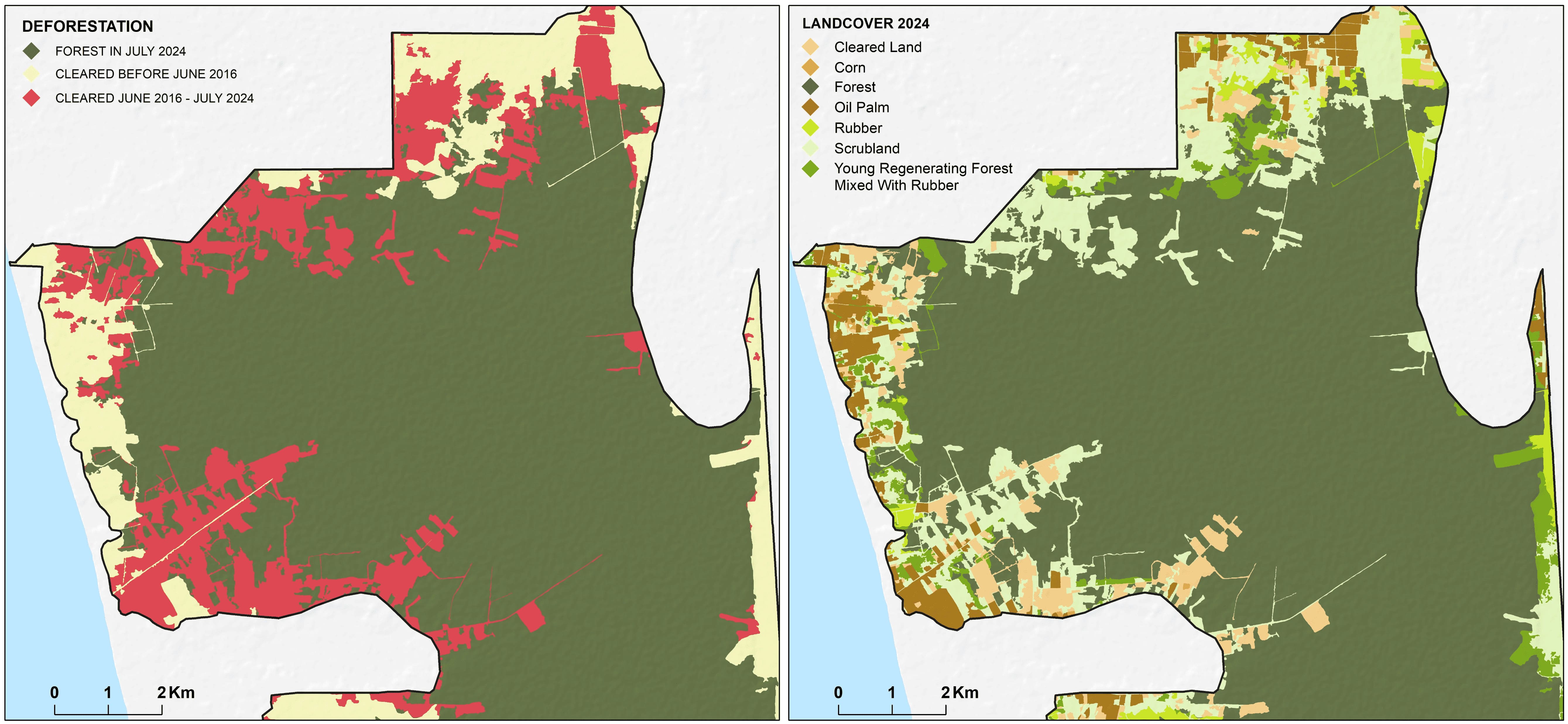
- Deforestation reached 2,577 ha between June 2016 and July 2024, with a further 713 ha cleared between July 2024 and January 2026.
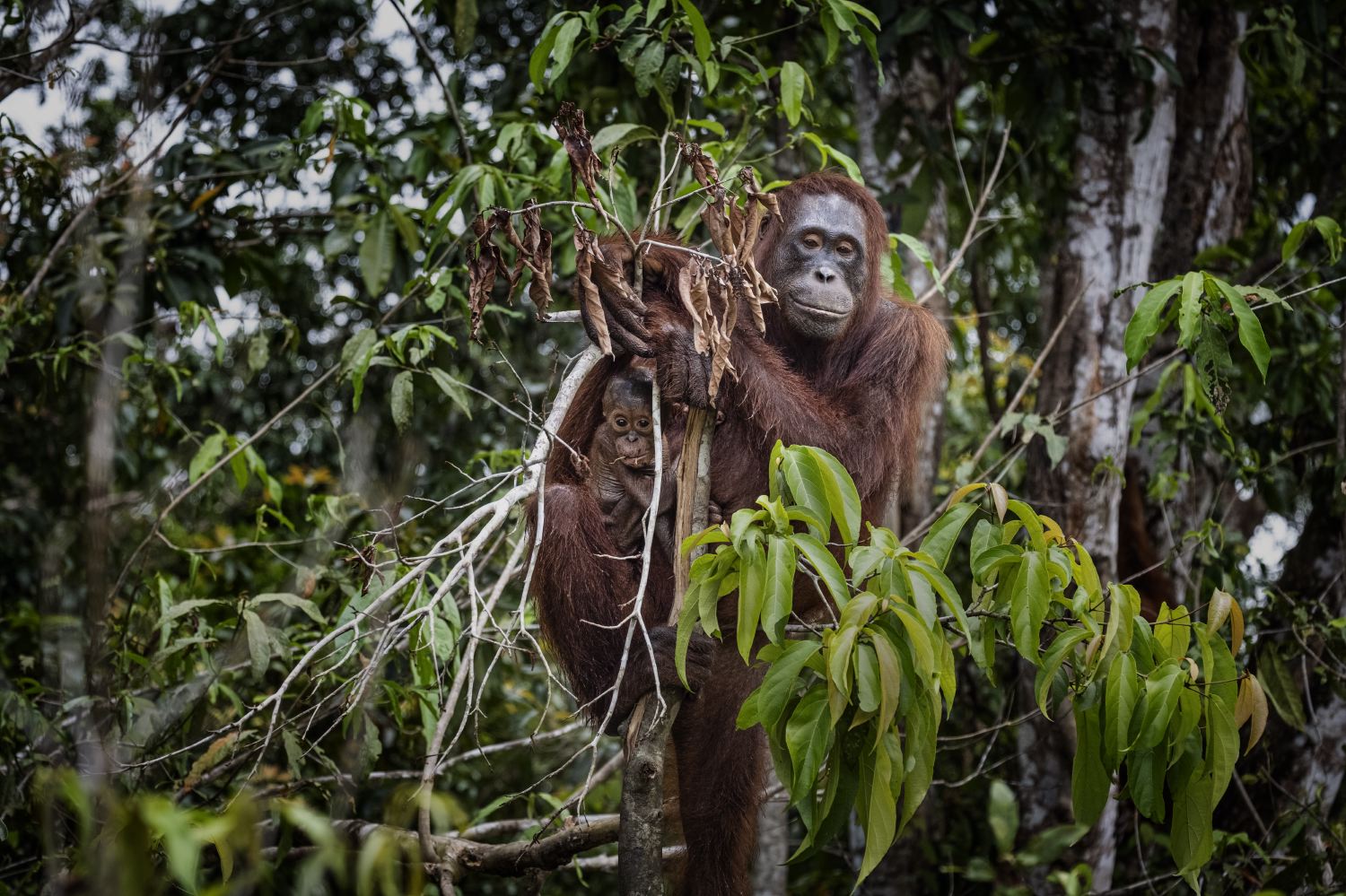
In the coastal peat-swamp forests of Aceh, Sumatra, Rawa Singkil Wildlife Reserve (82,000 ha) stands as one of Indonesia’s most vital strongholds for biodiversity and climate stability. Its deep peatlands store vast carbon reserves, while its forests provide habitat for remarkable wildlife, including around 1,500 orangutans.
Despite its protected status, illegal oil palm-driven land clearing has intensified in the northern third of Rawa Singkil since 2022.
Field investigations conducted by Rainforest Action Network (RAN) in September – October 2024 concluded that local land speculators, rather than smallholder farmers, drive illegal oil palm development inside the reserve. These individuals often hold multiple illegitimate land ownership certificates issued by complicit village authorities, and have sufficient financial resources to hire excavators to dig canals and clear peat forests. A documentary, Demi Sawit, released by Forum Jurnalis Lingkungan in 2023 reveals the connections between village authorities and local investors.
RAN traced fresh fruit bunches produced in these illegal plantations to two palm oil mills: PT Global Sawit Semesta (GSS) and PT Aceh Trumon Anugerah Kita (ATAK). These mills sell crude palm oil to major trading companies. The traders, in turn, supply multinational consumer goods companies such as Procter & Gamble, Nestlé, Mondelēz, PepsiCo, and Nissin Foods. Consumers could be unknowingly purchasing products made with illegal palm oil from Rawa Singkil.
Banks with no-deforestation policies, like MUFG, Rabobank, UBS, HSBC and ING, are also complicit in the destruction of the biodiversity haven in Rawa Singkil through their funding of traders that are exposed to the illegal palm oil, RAN said.
This trend has raised serious concerns among national and international conservation groups, who are calling for stronger protection and enforcement in this critically important landscape.
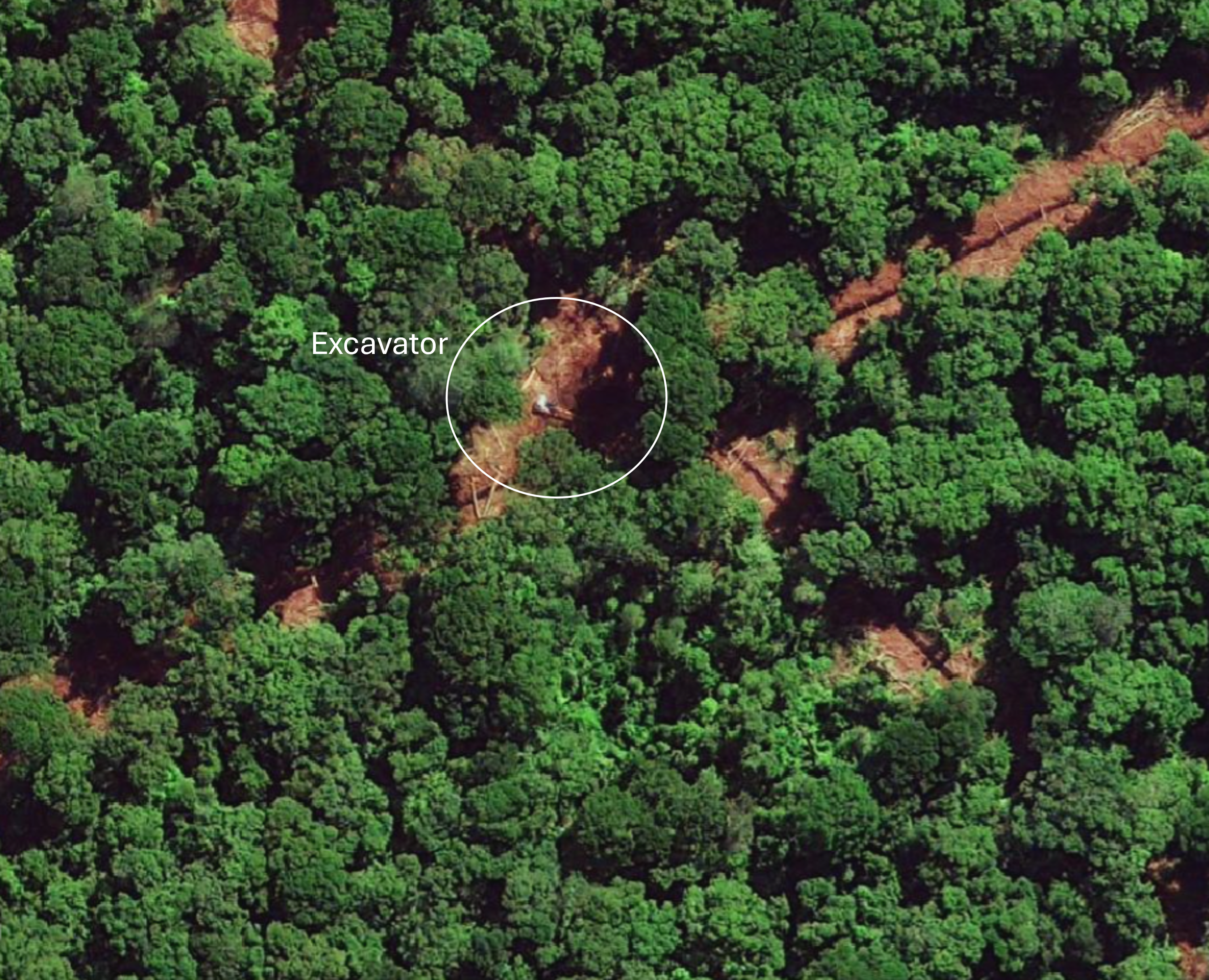
At the same time, public statements from the former Minister of Environment and Forestry have downplayed these threats by emphasising that Rawa Singkil remains 95% forested. In response, Rainforest Action Network and The TreeMap decided to bring evidence that nobody can dispute.
We tasked Pléiades Neo satellites from Airbus to acquire ultra–high-resolution imagery (30 cm) over Rawa Singkil during the summer of 2024. These data were complemented by very-high-resolution imagery (80 cm) acquired in June 2016 by TripleSat (21AT).
Using this imagery, we produced the first detailed map of oil palm plantations within the reserve. In total, 652 hectares of planted oil palm were identified by visual interpretation, of which 453 hectares correspond to plantations that were in production in 2024. The remaining areas consist of plantations that are still too young to be productive or areas that are only partially planted. Between June 2016 and July 2024, 2,577 hectares of primary forest were lost.
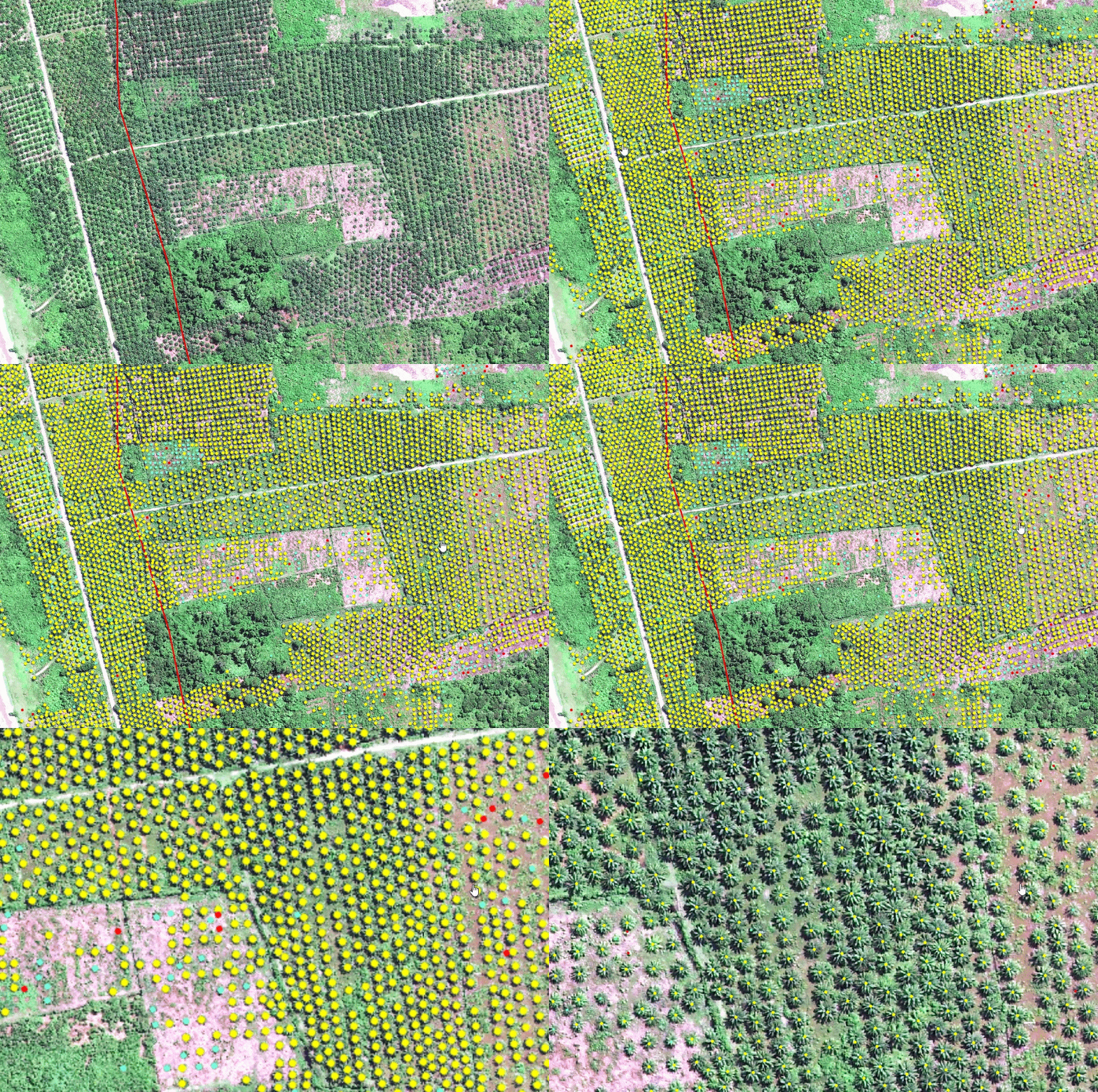
At The TreeMap we decided to go one step further by using AI to count individual palm trees and estimate both the production volume and the economic scale of illegal oil palm cultivation in the reserve. We trained a state-of-the-art object detection convolutional neural network (Faster R-CNN), developed in Torchgeo, for this purpose.
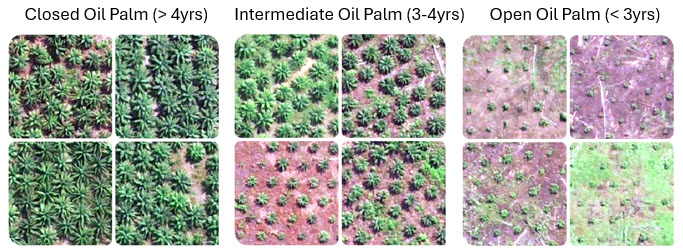
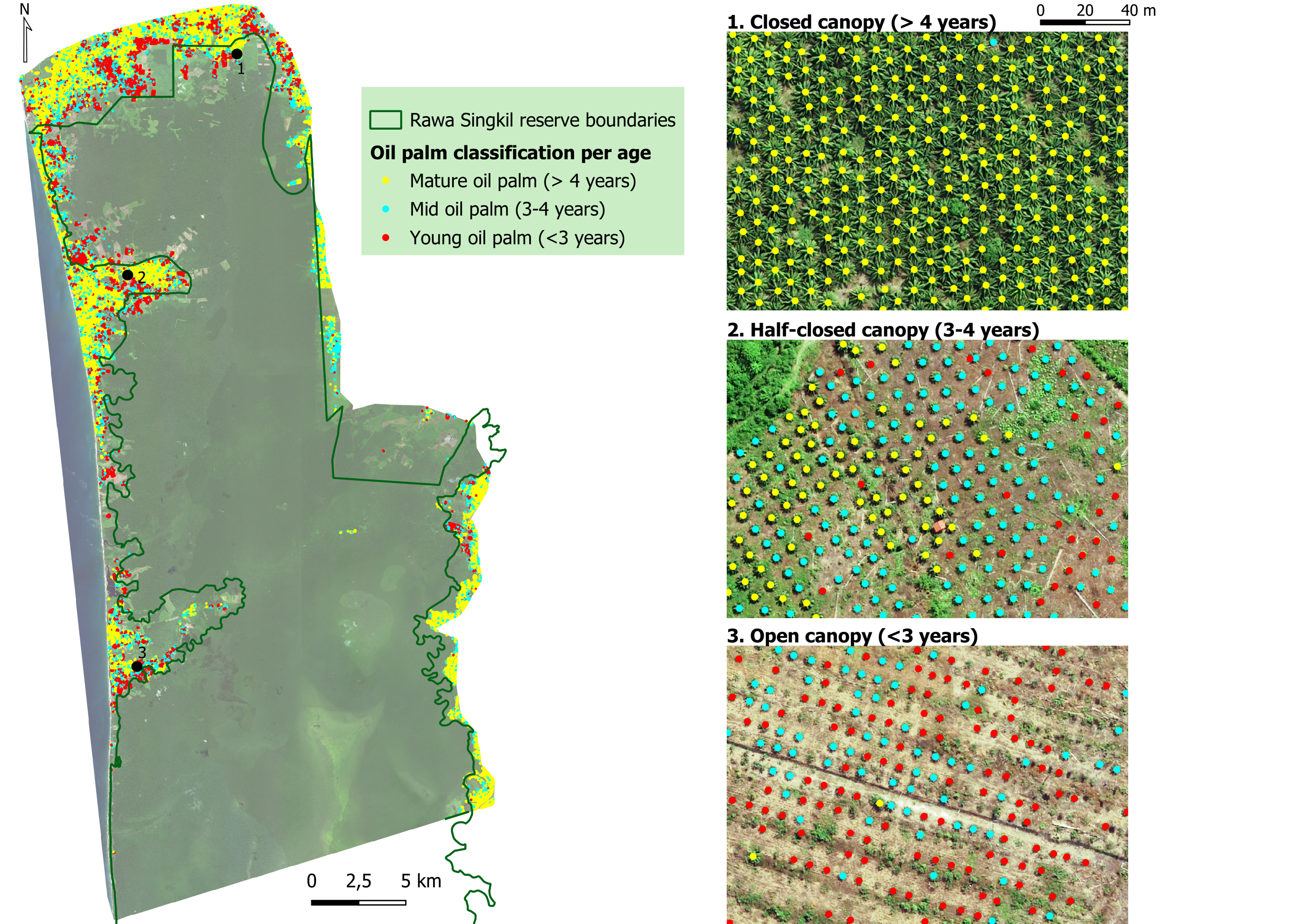
The palms, typically planted in an equilateral triangular pattern with approximately nine metres between trees, were classified by canopy cover, which is used here as a proxy for age and production stage. We distinguished three classes in the Pléiades Neo imagery : closed-canopy palms, representing mature palms older than four years and fully productive; half-closed-canopy palms, representing palms approximately three to four years old in early production; and open-canopy palms, younger than three years and not yet productive in 2024.
The R-CNN model detected a total of 62,006 oil palm trees within the reserve. Of these, 42,736 exhibit a closed canopy and 11,171 a half-closed canopy, resulting in 53,907 palms that were in production in 2024. The remaining 8,099 palms, classified as open-canopy, are included in the total planted area but were excluded from the 2024 production estimates because they are not yet productive.
Across the 453 hectares in production, the 53,907 producing palms correspond to an effective density of approximately 119 palms per hectare. These lower-than-theoretical densities are consistent with the illegal, informal, and fragmented nature of plantations inside the reserve, and reflect the presence of missing trees, mortality, unplanted or partially abandoned areas.
To estimate fresh fruit bunch (FFB) production in 2024, conservative yield assumptions were adopted, reflecting the conditions of informal, low-input plantations characterised by lower-yield planting material (seeds), limited fertiliser use, and harvest losses. Mature closed-canopy palms (> 5 years) were assumed to produce an average of 120 kg of FFB per palm per year, while half-closed-canopy palms (3-5 years) in early production were assumed to produce 40 kg per palm per year. Palms younger than three years were not included in the 2024 production estimate.
Under these assumptions, FFB production from mature palms was estimated at approximately 5,128 tonnes, while early-producing palms contribute an additional 447 tonnes. Total FFB production in 2024 was therefore estimated at 5,575 tonnes.
Conversion of FFB into crude palm oil (CPO) depends on the oil extraction rate (OER). A central OER value of 20% was adopted, with a plausible range of 18–22%. Using this central value, the estimated CPO production associated with illegal oil palm plantations in Rawa Singkil in 2024 was approximately 1,115 tonnes, with a plausible range between roughly 1,000 and 1,230 tonnes.
At the national scale, this volume is negligible. Indonesia produced approximately 48.16 million tonnes of crude palm oil in 2024, meaning that the estimated 1,115 tonnes from Rawa Singkil represent only about 0.0023% of national production. However, at the operational level, this volume is significant: it corresponds to roughly one full week of milling under realistic operating conditions for a palm oil mill with a processing capacity of 45 tonnes of FFB per hour.
From an economic perspective, applying conservative farm-gate prices for fresh fruit bunches in Indonesia indicates that this level of production corresponds to approximately Rp 12–17 billion (US$0.8–1.1 million) per year in gross revenue. This figure represents annual turnover before costs and provides an order-of-magnitude estimate of the economic activity generated by illegal oil palm cultivation inside Rawa Singkil, an essential input for informed discussions on enforcement, restoration, and potential compensation or transition schemes.
These results provide the first robust estimate of illegal oil palm production and its economic value within this critical wildlife reserve. They establish a quantitative foundation for assessing the economic scale of illegal occupation and support informed, transparent, and fair discussions on enforcement, restoration, and potential compensation or transition schemes if illegal plantations are removed.
Established in 1998, Rawa Singkil Wildlife Reserve is a globally recognised biodiversity hotspot within Aceh’s Leuser Ecosystem. Yet the reserve remains in a state of environmental emergency. Between June 2016 and July 2024, 2,577 hectares of primary forest were lost, with an additional 713 hectares cleared between July 2024 and January 2026. The evidence presented here underscores the urgent need for active and sustained law enforcement to halt further encroachment, remove illegal plantations, and restore the ecological integrity of this vital wildlife reserve.