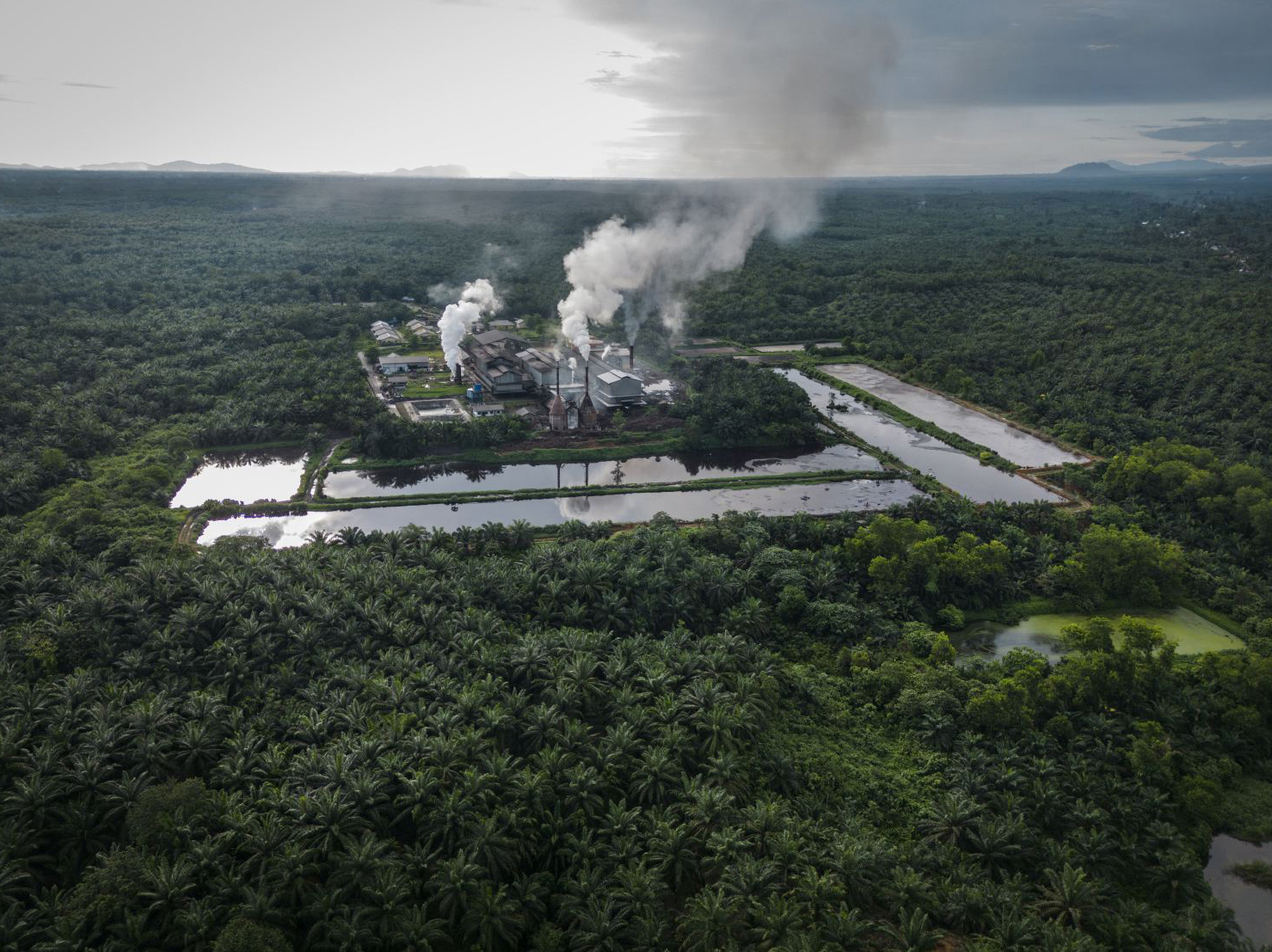
 Industrial palm oil mill surrounded by large-scale oil palm plantations in Kalimantan
 Palm-Oil-Driven Deforestation Stable in Indonesia in 2025 but Doubles in Papua
Industrial palm oil mill surrounded by large-scale oil palm plantations in Kalimantan - Industrial oil palm expansion declined in Indonesia in 2025, yet associated deforestation remained stable.
- By contrast, forest conversion to industrial oil palm doubled in Indonesian Papua, reaching its highest level since 2018.
- 65 oil-palm concessions engaged in forest conversion, and 28 in peat conversion in 2025.
- The Fangiono family was the largest driver of oil-palm-related deforestation in Indonesia in 2025, accounting for roughly one-third of recorded palm-oil-driven deforestation and leading the observed shift of plantation expansion toward Papua.
- The 2025 data also highlight the group’s expansion into new frontiers, including through PT Citra Sugi Aditya (CSA), which is developing oil palm estates on Lingga Island in the Riau Islands.
- Peatland conversion fell in 2025, but persisted in sensitive landscapes, including around Danau Sentarum National Park, largely driven by the First Borneo Group.
- Even RSPO-certified concessions exploited loopholes to expand on peat despite NDPE commitments.
- The 2025 data also highlight the emergence of new actors, including Citra Sugi Aditya (CSA), a newcomer developing oil palm estates in the Riau Islands.
________________________________________________________________________________________________________________
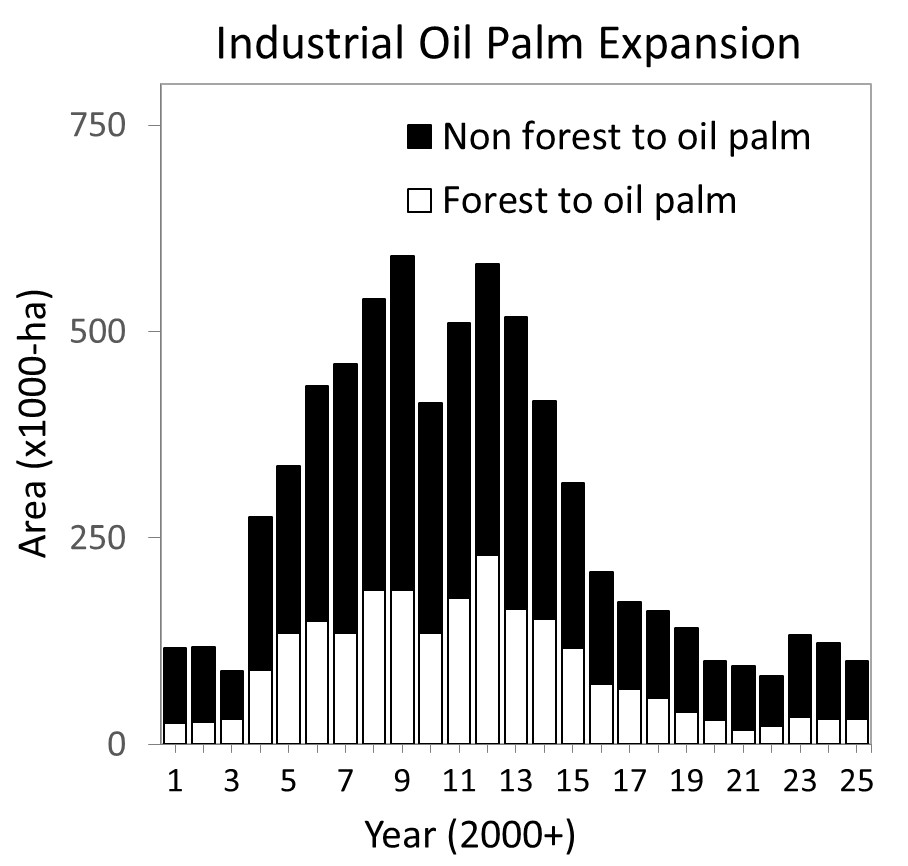
Industrial oil palm expansion slowed in 2025, but associated deforestation did not. Satellite analysis using Sentinel-2 and Planet imagery reveals that industrial oil palm plantations expanded by 101,120 ha in 2025 (White and black bars; Figure 1), an 18% decrease from the previous year. Despite this slowdown, the associated deforestation showed no decline, totalling 31,073 hectares in 2025 compared to 30,956 hectares in 2024 (White bars; Figure 1).
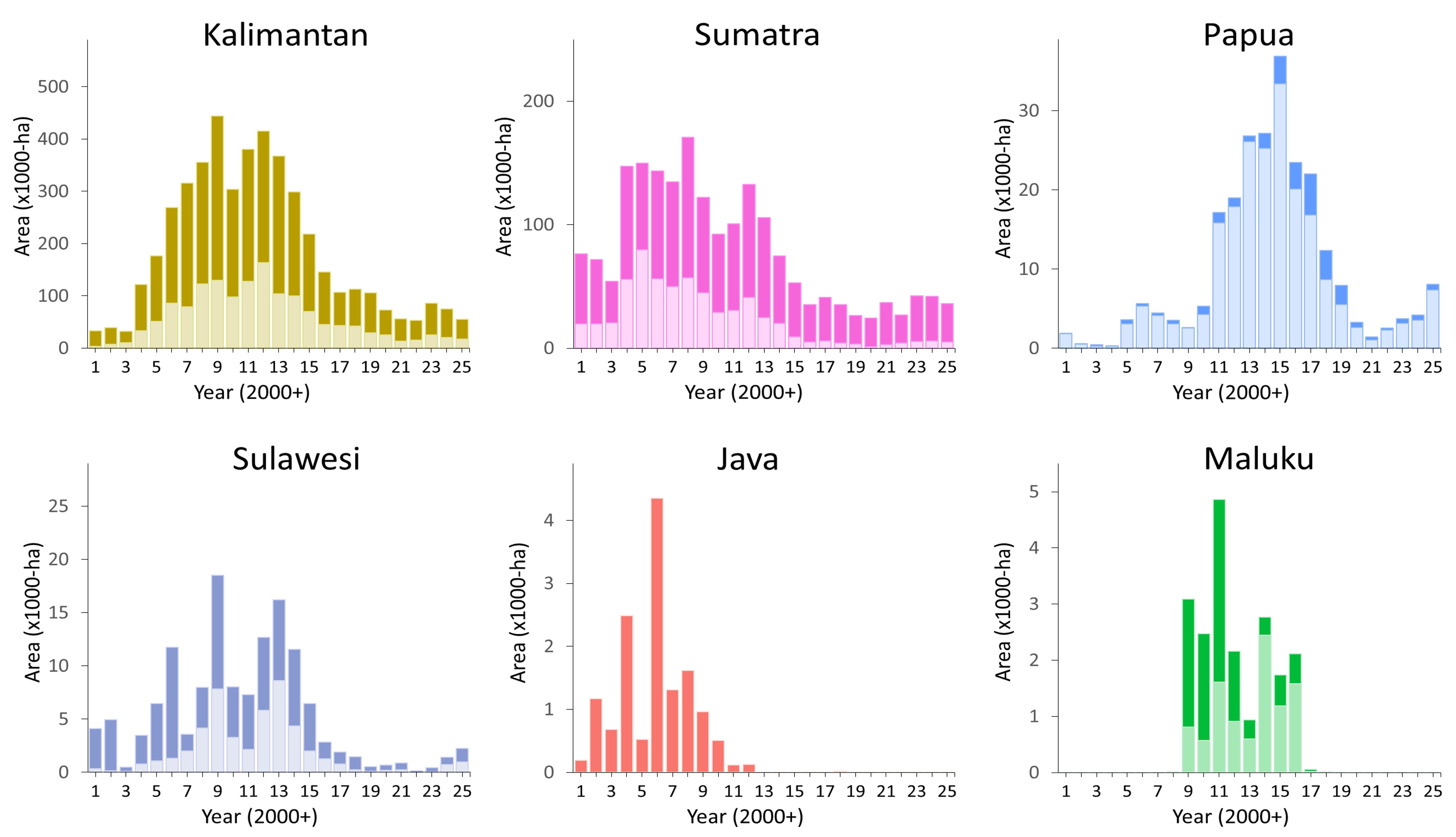
At the regional level, both plantation expansion (light and dark bars; Figure 2) and associated deforestation (light bars; Figure 2) declined in Kalimantan and Sumatra; but increased in Papua, and to a lesser extent in Sulawesi.
In Papua, palm-oil-driven deforestation doubled, reaching 7,333 ha cleared compared with 3,510 ha in 2024, marking the highest annual level since 2018. This pattern suggests an eastward shift in plantation expansion from Sumatra and Kalimantan, where remaining land availability has become increasingly limited, toward Papua.
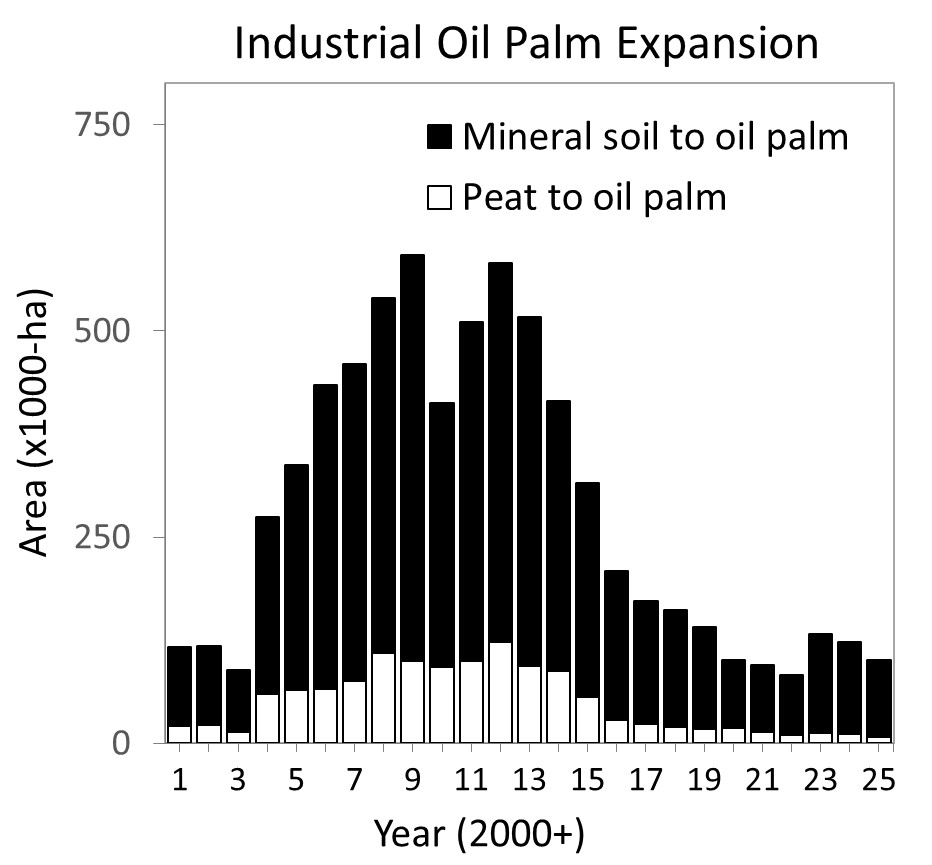
The conversion of peatlands for industrial palm oil cultivation saw a 35% drop, with a total of 7,593 hectares cleared in 2025 compared to 11,686 hectares the previous year (white bars; Figure 3).
At the concession level, 65 oil-palm concessions engaged in deforestation, and 28 in peat conversion in 2025 (Tables 1 and 2). This figure underestimates the total number of concessions involved, as the recorded forest clearing in concessions (21,823 ha), represents two-thirds of the 31,073 hectares deforested for oil-palm expansion in 2025.
Group-level aggregation shows that the Fangiono Family was the largest actor in oil-palm-related deforestation in 2025, for the third consecutive year, accounting for approximately 9,355 hectares of forest conversion (30% of total deforestation for oil palm) through its network of companies, including Ciliandry Anky Abadi (CAA), New Borneo Agri / Sulaidy, and FNG Bona Nusantara. Nearly 70% of this clearing (~6,179 ha) occurred in Papua.
The 2025 data also point to a new frontier and a new company linked to the Fangiono group: PT Citra Sugi Aditya (CSA), majority-owned by Ciliandry Angky Abadi, which is developing new oil palm plantations on Lingga Island (in Limbung and Teluk villages, Kabupaten Lingga).
Past reporting in regional media has highlighted irregularities and disputes related to the company’s licensing history. Although the 2025 clearing occurred within a valid HGU, the case underscores the importance of considering both current land legality and historical permitting trajectories when evaluating emerging deforestation actors. This development signals a distinct coastal and small-island frontier for plantation expansion, geographically separate from the large forest blocks of Papua and Kalimantan.
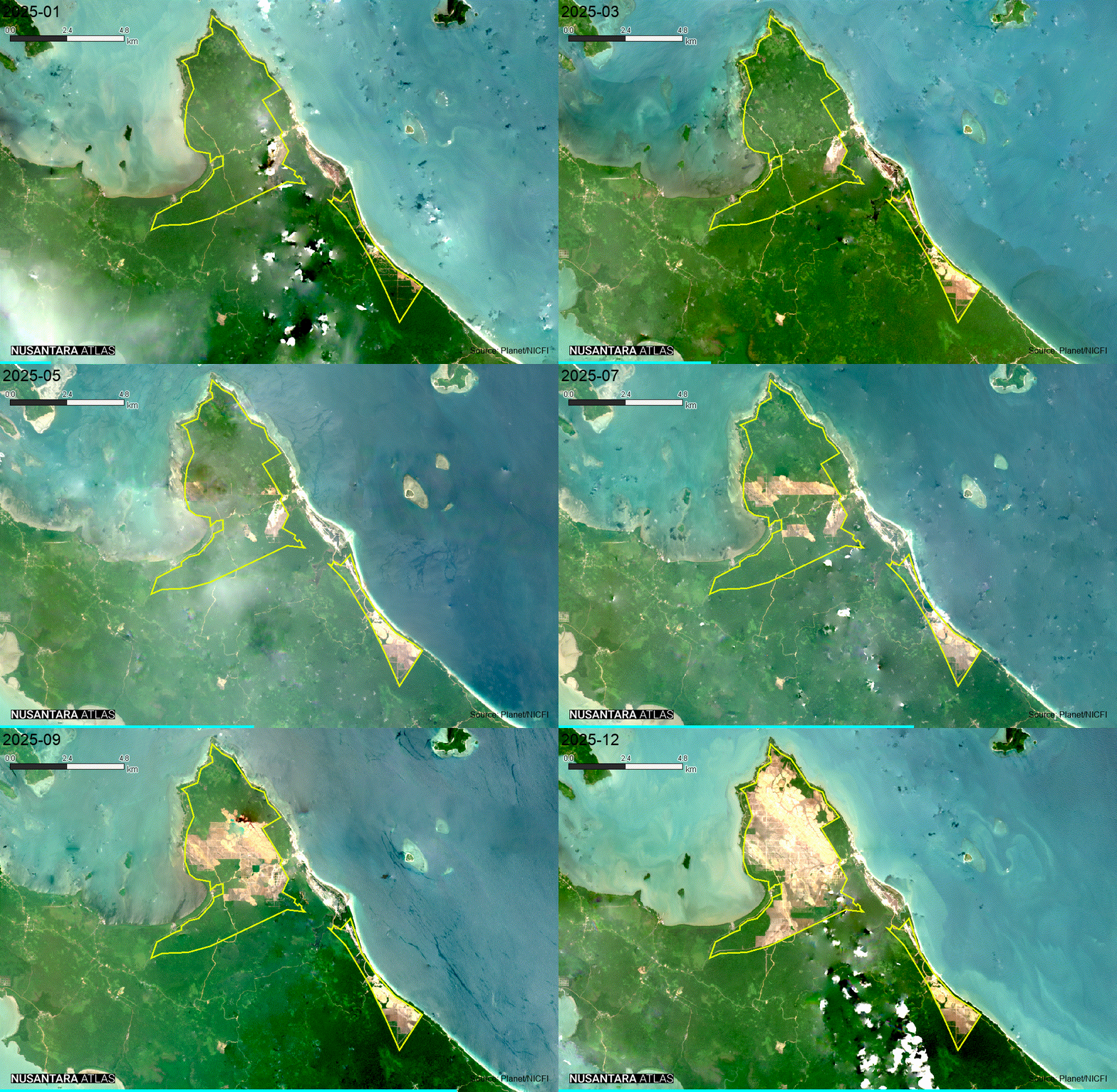
The Fangiono also own First Resources, a Singapore-based palm oil producer, that sells “sustainable” palm oil certified by the Roundtable on Sustainable Palm Oil (RSPO), the industry’s leading voluntary sustainability standard.
As early as 2021, civil society organisations lodged complaints with the RSPO concerning undisclosed relationships between these companies. The RSPO Secretariat dismissed allegations in 2025 and ruled that First Resources had not breached its membership rules. This decision has drawn strong condemnations from environmental organisations. In a joint statement, NGOs described the ruling as setting “a dangerous precedent,” warning that it may enable companies to retain RSPO certification and keep clearing forests. The observation that Fangiono-linked companies were the largest contributors to forest conversion in 2025 lends support to these concerns.
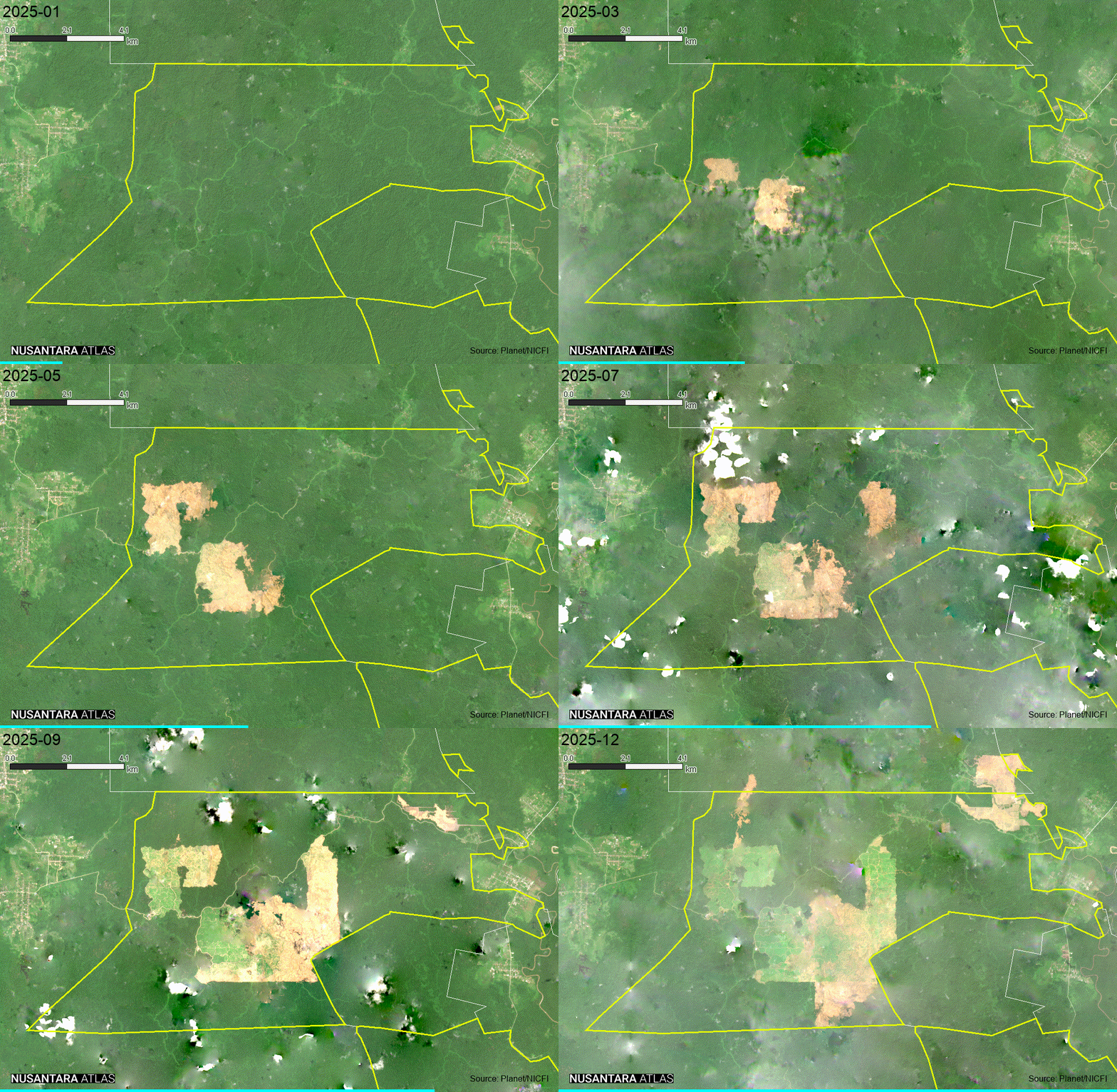
Another RSPO member, Bumitama, was associated with deforestation in 2025, clearing 390 hectares within its concession PT Karya Makmur Langgeng.
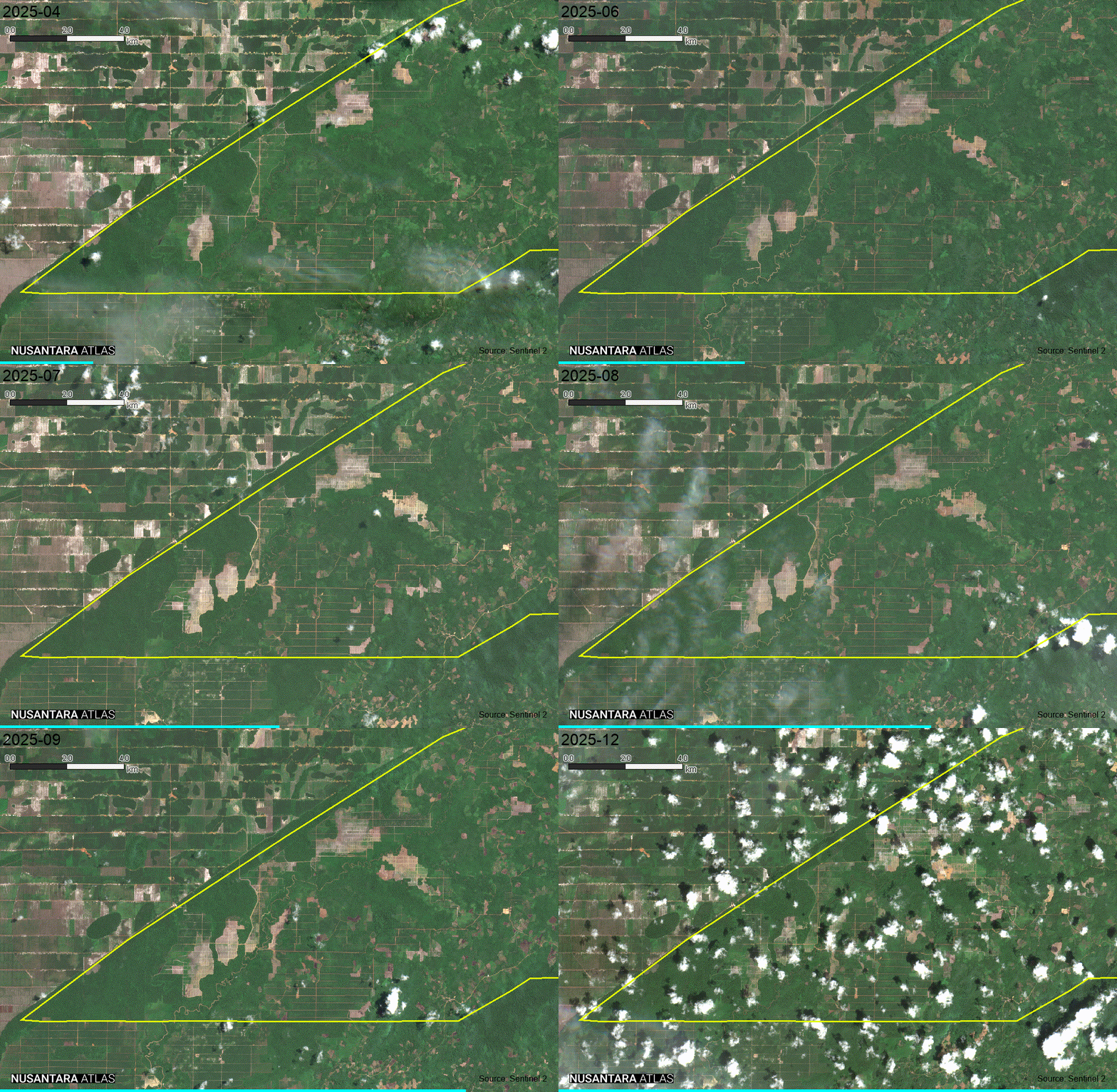
Similarly, RSPO member SIPEF converted 109 hectares of peatland within its RSPO-certified concession PT Dendymarker Indah Lestari. SIPEF notes that independent assessors had initially classified the affected area as unsuitable for development (“no-go”). The company subsequently disputed this conclusion, stating that its “No New Peat” policy applies only to new development areas and that the expansion we observe in 2025 on peat occurred within previously planted land, which it considers to be managed in accordance with RSPO requirements.
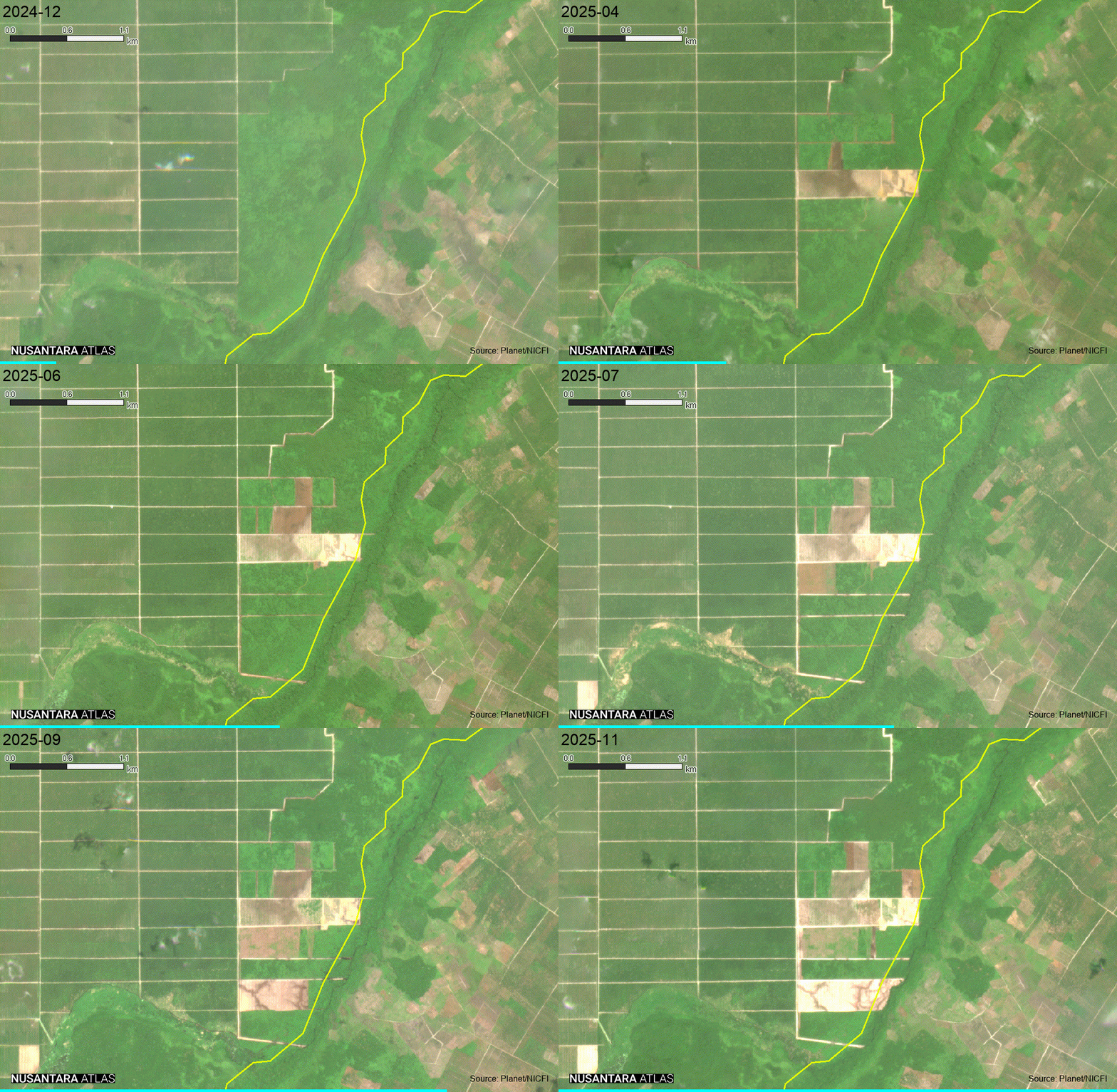
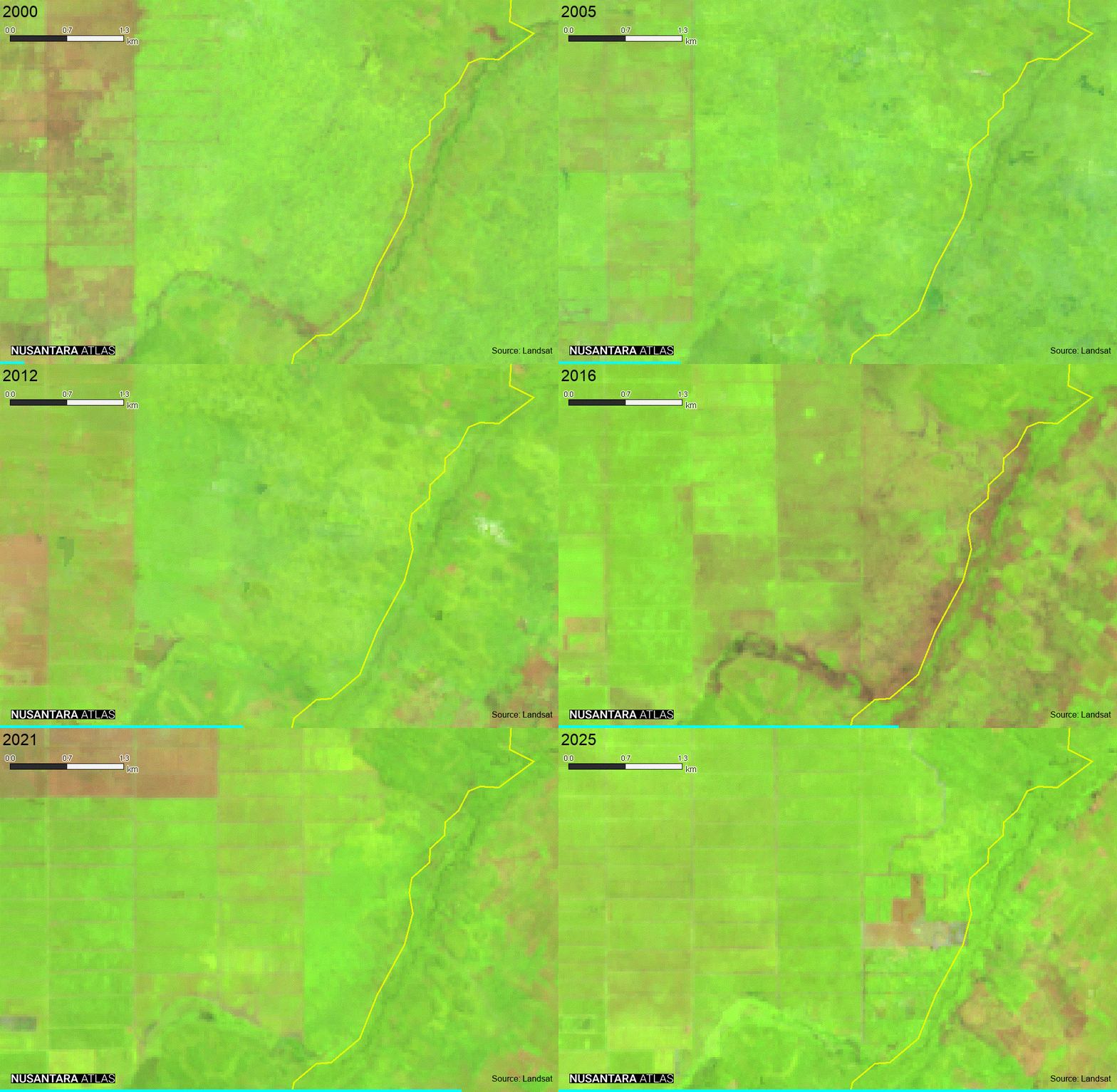
A longer historical satellite time-series indicates minimal prior development in the affected area prior 2025. About 30 hectares were cleared in 2013, followed by widespread fire at the end of 2015, visible in 2016 imagery. There is no evidence of established plantation patterns across most of the site before the recent 2025 clearing. There is, however, evidence of peat degradation by fire. This questions whether the 2025 activity can reasonably be characterized as legacy plantation management rather than new peatland conversion. Instead of restoring burned peatlands, this RSPO-certified company is converting them to oil palm. As such, the clearings raise concerns regarding alignment with RSPO’s no-deforestation and no-peatland conversion commitments. This case provides a clear example of how converting forests to oil palm on peatlands increases fire risk and results in substantial carbon emissions.
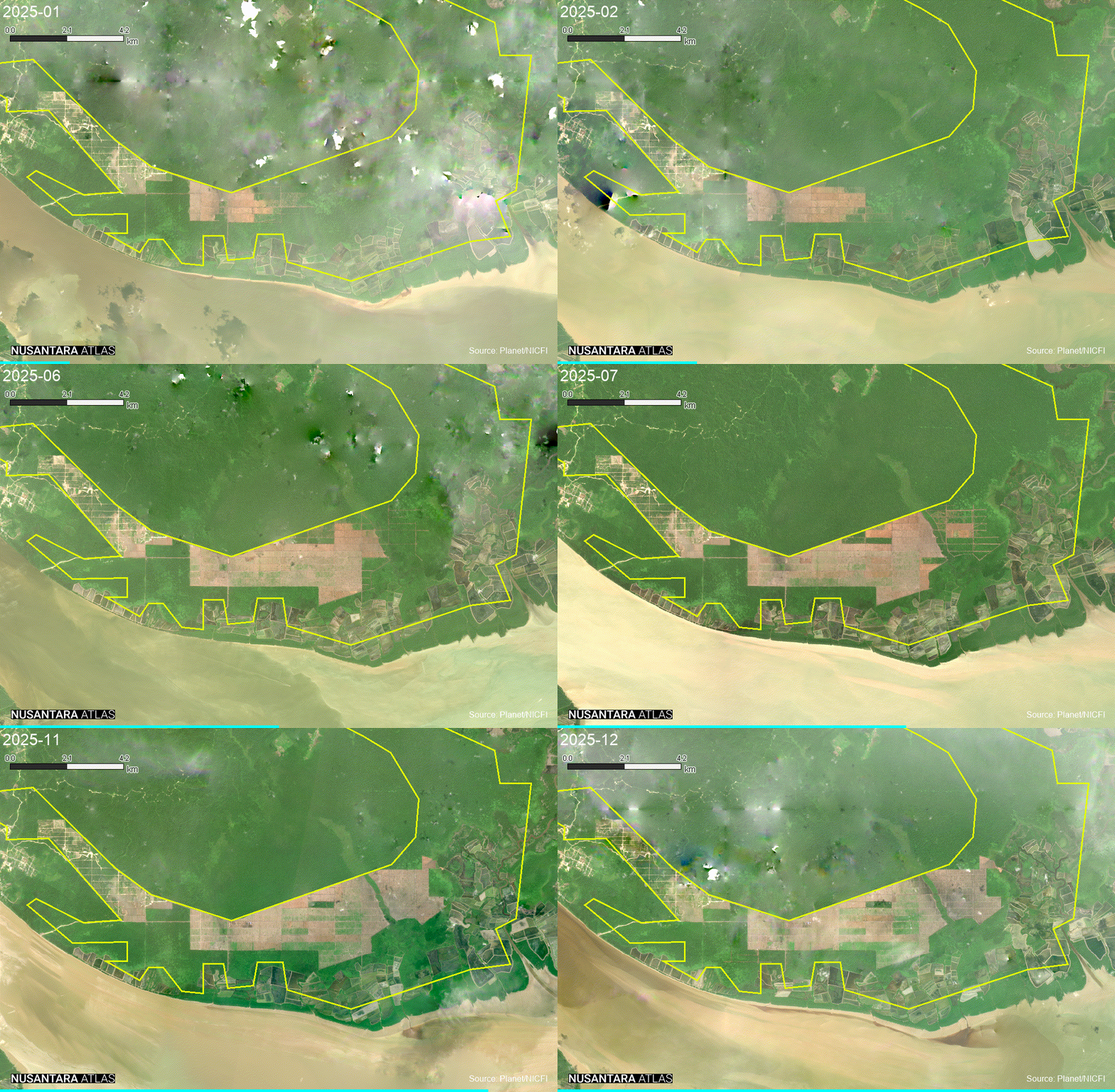
First Borneo Group ranked as the second largest actor, with 2,940 hectares of forest conversion. In contrast to Fangiono, whose clearing was concentrated in Papua, First Borneo’s expansion occurred predominantly in West Kalimantan across three concessions (PT Equator Sumber Rezeki, PT Borneo International Anugerha, and PT Khatulistiwa Agro Abadi). Much of this clearing is located within peat swamp forests surrounding Danau Sentarum National Park, a globally significant wetland ecosystem for climate mitigation and orangutan habitat. Satellite observations further suggest that clearing associated with PT Equator Sumber Rezeki extends beyond its mapped concession boundary.
The First Borneo Group is ultimately owned by Alexander Thaslim and his family through Chancellor Oil Pte Ltd (Singapore), itself wholly owned by Premier Palmoil Energy Pte Ltd (Singapore). The First Borneo Group does not own any mill in West Kalimantan, instead relies on third-party mills located up to 150 km away. This distance challenges the common assumption that plantation supply is typically limited to a 50 km radius around mills, suggesting that sourcing networks may extend significantly farther than often assumed, as road infrastruture improve.
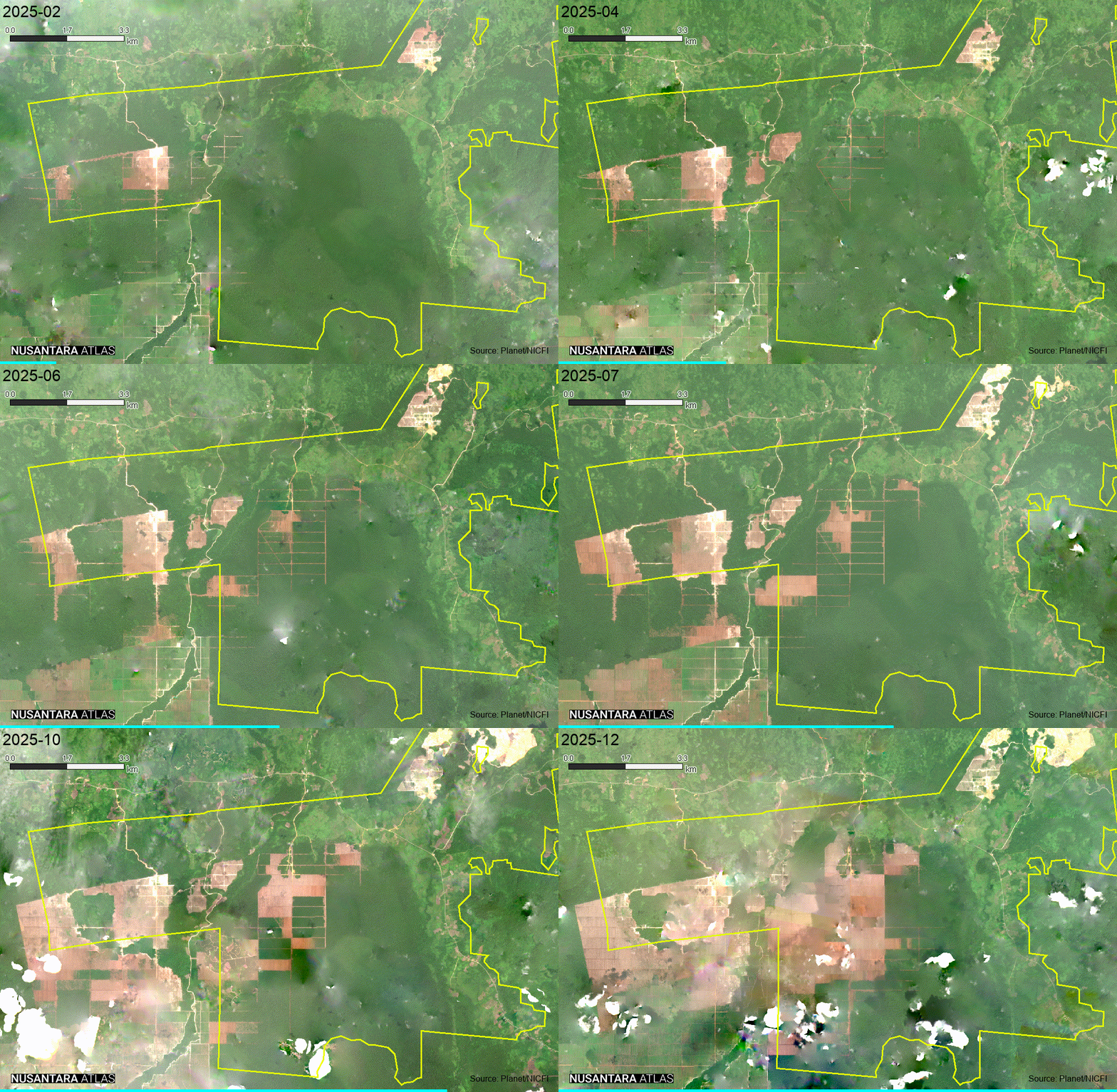
PT Mulia Agro Utama stands out as an individual concession, having converted approximately 1,394 hectares of forest in North Kalimantan. The concession was sold to Longstar Investment in 2025 by the Chinese Julong Group. Longstar Investment Pte Ltd (Singapore) which is 100% owned by Zhang Ying (Chinese citizen), although little else is known about this group, underscoring the role of emerging or less scrutinized plantation investors from China and Singapore in driving frontier deforestation dynamics.
Beyond the Fangiono, First Borneo, and Prima Antar Surya groups, and Longstar Investment, forest conversion in 2025 was distributed across a diverse set of concessions operated by a wide range of companies. These concessions typically cleared between 20 and 700 hectares each and collectively represent a significant share of national oil-palm-related deforestation and peat conversion. Several belong to well-known plantation groups, including Jhonlin Group, Salim/IndoGunta, Korindo, Bumitama, DTK Opportunity/RGE, and Sinar Mas (GAR), while many others fall into “Unknown” ownership categories. The presence of numerous concessions with opaque parent-group affiliations highlights the persistent limited transparency of Indonesia’s plantation sector. Alongside dominant corporate networks, a broad constellation of smaller and mid-scale operators continues to contribute to forest loss across Kalimantan, Sulawesi, Sumatra, and Aceh.
Table 1. List of companies converting old-growth/primary forest to industrial monoculture oil palm in 2025. The table includes only conversion events exceeding 50 hectares that were confidently identified as deforestation for oil palm.
| No | Company Name | Group | Concession (Ha) | Province | Deforestation for oil palm | ||
| 1 | Sorong Global Lestari (SGL) | FNG Boga Nusantara / Fangiono | 13,052 | Papua Barat Daya | 2,383 | ||
| 2 | Inti Kebun Sejahtera | Ciliandry Anky Abadi / Fangiono | 21,885 | Papua Barat Daya | 2,024 | ||
| 3 | Citra Sugi Aditya | Ciliandry Anky Abadi / Fangiono | 2,970 | Riau Islands | 1,555 | ||
| 4 | Mulia Agro Utama | Longstar Investment Pte Ltd/Julong group | 14,024 | North Kalimantan | 1,394 | ||
| 5 | Papua Agri Mandiri (PAM) | Ciliandry Anky Abadi / Fangiono | 31,862 | Southwest Papua | 1,274 | ||
| 6 | Equator Sumber Rezeki | First Borneo | 12,051 | West Kalimantan | 1,152 | ||
| 7 | PT Anugrah Surya Mandiri | Ciliandry Anky Abadi / Fangiono | 2,676 | East Kalimantan | 765 | ||
| 8 | Borneo International Anugerah | First Borneo | 20,016 | West Kalimantan | 751 | ||
| 9 | Bumi Agro Makmur | Unknown | 5,495 | Central Kalimantan | 723 | ||
| 10 | Khatulistiwa Agro Abadi | First Borneo | 16,868 | West Kalimantan | 650 | ||
| 11 | Tunas Hutan Mandiri | Jhonlin Group | 12,484 | South Kalimantan | 639 | ||
| 12 | Kaltim Hijau Makmur | CT Agro | 15,157 | East Kalimantan | 509 | ||
| 13 | Subur Karunia Raya | Salim / IndoGunta | 38,600 | Papua Barat | 499 | ||
| 14 | Inti Kebun Sawit | Ciliandry Anky Abadi / Fangiono | 13,344 | Southwest Papua | 498 | ||
| 15 | Nusamas Griya Lestari | Unknown | 5,714 | Central Sulawesi | 467 | ||
| 16 | Karya Makmur Langgeng | Bumitama | 19,108 | West Kalimantan | 390 | ||
| 17 | Loka Indah Lestari | Unknown | 15,410 | Gorontalo | 366 | ||
| 18 | Anugrah Niaga Sawindo | Other/unknown | 7,982 | Riau | 347 | ||
| 19 | Setia Agro Abadi | New Borneo Agri / Sulaidy / Fangiono | 20,194 | East Kalimantan | 318 | ||
| 20 | Sawit Jaya Makmur | Alas Kusuma | 15,393 | West Kalimantan | 264 | ||
| 21 | Borneo Citra Persada Jaya | New Borneo Agri / Sulaidy / Fangiono | 12,526 | East Kalimantan | 261 | ||
| 22 | Wana Subur Sawit Indah | Unknown | 5,699 | Riau | 251 | ||
| 23 | Jalin Vaneo | Pasifik Agro Sentosa | 12,731 | West Kalimantan | 248 | ||
| 24 | Iska Bekai | Tunas Sawa Erma (TSE) / Korindo | 5,720 | South Papua | 232 | ||
| 25 | Berkah Sawit Abadi | First Borneo | 34,000 | West Kalimantan | 211 | ||
| 26 | Mitra Sawit Makmur | Other/unknown | 7,119 | East Kalimantan | 182 | ||
| 27 | Cipta Papua Plantation | Ciptana Group | 10,514 | Southwest Papua | 182 | ||
| 28 | Agrindo Sukses Sejahtera | Starmas Sentosa Mandiri | 5,384 | East Kalimantan | 181 | ||
| 29 | Saraswanti Sawit Makmur | Saraswanti | 5,428 | East Kalimantan | 171 | ||
| 30 | Perkebunan Inti Sendawar | IMC Plantations | 15,962 | East Kalimantan | 147 | ||
| 31 | Alam Lestari Indah | Mekong Group Holdings / Tanoto/Royal Golden Eagle | 9,871 | Central Kalimantan | 145 | ||
| 32 | Citra Palma Pertiwi | New Borneo Agri / Sulaidy / Fangiono | 11,081 | East Kalimantan | 143 | ||
| 33 | Cipta Usaha Sejati | Pasifik Agro Sentosa | 18,039 | West Kalimantan | 134 | ||
| 34 | Uniseraya | Uniseraya | 8,692 | Riau | 119 | ||
| 35 | Bintang Sakti Lengana | Bangkit Giat Usaha Mandiri | 5,906 | Central Kalimantan | 115 | ||
| 36 | Wahana Hamparan Hijau | First Borneo | 19,724 | West Kalimantan | 115 | ||
| 37 | Permata Sawit Mandiri | Sepanjang (formerly Genting) | 16,770 | West Kalimantan | 114 | ||
| 38 | Palem Segar Lestari (Plasma) | Unknown | 2,564 | North Kalimantan | 110 | ||
| 39 | Nia Yulided Bersaudara | Unknown | 2,179 | Aceh | 107 | ||
| 40 | Blang Ara | Unknown | 5,621 | Aceh | 100 | ||
| 41 | Singkep Payung Perkasa | Unknown | 17,643 | Riau Islands | 96 | ||
| 42 | Tewah Bahana Lestari | DTK Opportunity / Tanoto/Royal Golden Eagle | 7,390 | Central Kalimantan | 79 | ||
| 43 | Citra Agro Abadi | Ciliandry Anky Abadi /Fangiono | 9,199 | Central Kalimantan | 75 | ||
| 44 | Putra Kurnia | Unknown | 1,783 | Aceh | 74 | ||
| 45 | Buruk Bakul | Unknown | 1,983 | Riau | 71 | ||
| 46 | Kalimantan Ria Sejahtera | DTK Opportunity / Tanoto/Royal Golden Eagle | 12,335 | Central Kalimantan | 70 | ||
| 47 | Harapan Hibrida Kalbar | Rachmat/Union Sampoerna Triputra Persada (JV between Rachmat and Union Sampoerna) | 9,570 | West Kalimantan | 69 | ||
| 48 | Surya Panen Subur | Rachmat/Amara | 14,865 | Aceh | 68 | ||
| 49 | Archipelago Timur Abadi | DTK Opportunity Tanoto / Royal Golden Eagle | 14,992 | Central Kalimantan | 68 | ||
| 50 | Permata Nusa Mandiri | Salim/IndoGunta | 14,690 | Papua | 65 | ||
| 51 | Bina Karya Nuansa Sejahtera | Panca Karya Marga Bhakti | 2,336 | East Kalimantan | 65 | ||
| 52 | Wana Catur Jaya Utama | Rajawali/Eagle High | 11,387 | Central Kalimantan | 64 | ||
| 53 | Pinang Witmas Abadi | Pinang Witmas Sejati | 10,548 | West Kalimantan | 63 | ||
| 54 | Kapuas Bio Agro | First Borneo | 17,380 | West Kalimantan | 61 | ||
| 55 | Marsam Citra Adiperkasa | Perkebunan Agro Keluarga Fangiono/Fangiono | 12,297 | East Kalimantan | 59 | ||
| 56 | Berkat Nabati Sejahtera | IOI Corporation | 8,523 | West Kalimantan | 59 | ||
| 57 | Sariwana Adi Perkasa | Goodhope | 9,725 | Central Papua | 57 | ||
| 58 | Brahma Bina Bakti | Rachmat/Triputra | 5,684 | Jambi | 56 | ||
| 59 | Batu Mas Sejahtera | Goodhope | 10,248 | West Kalimantan | 55 | ||
| 60 | Kalimantan Hamparan Sawit | Abdi Budi Mulia | 14,810 | Central Kalimantan | 54 | ||
| 61 | Ruta Jona Lestari | Other/unknown | 20,729 | Central Kalimantan | 53 | ||
| 62 | Hardaya Inti Plantations | Central Cipta Murdaya (Murdaya Family) | 27,643 | Central Sulawesi | 52 | ||
| 63 | Sumber Sawit Mitrajaya | Other/unknown | 15,111 | East Kalimantan | 52 | ||
| 64 | Nunukan Jaya Lestari | Sinar Mas (GAR) | 21,382 | North Kalimantan | 51 | ||
| 65 | Alam Sari Lestari | Other/unknown | 12,446 | Riau | 51 |
Table 2. List of companies converting peatlands to industrial monoculture oil palm in 2025. This table only shows conversion >20 ha.
| No | Company Name | Parent group | Concession (Ha) | Location | Clearing on peat (Ha) | ||
| 1 | Borneo International Anugerah | First Borneo | 20,016 | West Kalimantan | 801 | ||
| 2 | Tempirai Palm Resources | Unknown | 3,213 | Sumatera Selatan | 732 | ||
| 3 | Uniseraya | Uniseraya | 8,692 | Riau | 532 | ||
| 4 | Dinamika Graha Sarana | Dinamika Graha Sarana / Sungai Budi | 17,560 | Sumatera Selatan | 420 | ||
| 5 | Wana Subur Sawit Indah | Unknown | 5,699 | Riau | 383 | ||
| 6 | Wahana Hamparan Hijau | First Borneo | 19,724 | West Kalimantan | 282 | ||
| 7 | Sawit Jaya Makmur | Alas Kusuma | 15,393 | West Kalimantan | 279 | ||
| 8 | Alam Sari Lestari | 12,446 | Riau | 227 | |||
| 9 | Inti Kebun Sejahtera | Ciliandry Anky Abadi / Fangiono | 21,885 | Southwest Papua | 178 | ||
| 10 | Surya Panen Subur | Rachmat/Amara | 14,865 | Aceh | 171 | ||
| 11 | Ricky Kurniawan Kertapersada | Makin | 3,836 | Jambi | 149 | ||
| 12 | Buruk Bakul | Unknown | 1,983 | Riau | 136 | ||
| 13 | Sawit Desa Kapuas | Surya Borneo Indah | 26,278 | West Kalimantan | 113 | ||
| 14 | Dendymarker Indah Lestari | SIPEF | 17,083 | Sumatera Selatan | 109 | ||
| 15 | Palem Segar Lestari (Plasma) | Unknown | 2,564 | North Kalimantan | 93 | ||
| 16 | Pinang Witmas Abadi | Pinang Witmas Sejati | 10,548 | West Kalimantan | 89 | ||
| 17 | Sumber Sawit Mitrajaya | Unknown | 15,111 | East Kalimantan | 82 | ||
| 18 | Arjuna Utama Sawit | First Borneo | 12,827 | Central Kalimantan | 67 | ||
| 19 | Sinar Karya Mandiri | Palma Agro Lestari | 10,531 | West Kalimantan | 57 | ||
| 20 | Tania Binatama | Sampoerna Agro | 5,108 | Sumatera Selatan | 49 | ||
| 21 | Kalbar Maju Dinamika | Unknown | 6,259 | West Kalimantan | 41 | ||
| 22 | Lahan Agro Inti Ketapang | Meadows Capital / Tanoto/Royal Golden Eagle | 12,472 | West Kalimantan | 37 | ||
| 23 | Koperasi Linggar Jati | Unknown | 1,429 | West Kalimantan | 36 | ||
| 24 | Toba Indah (Block B) | Unknown | 2,376 | Riau | 31 | ||
| 25 | Kalista Alam | Unknown | 6,060 | Aceh | 29 | ||
| 26 | Mitrakarya Agroindo | Sinar Mas (GAR) | 22,929 | Central Kalimantan | 26 | ||
| 27 | Perkebunan Nusantara XIII | Perkebunan Nusantara | 74,073 | West Kalimantan | 24 | ||
| 28 | Palm Beach Indonesia | Unknown | 14,419 | West Kalimantan | 23 |
The TreeMap endeavours to protect tropical forests through scientific research and advanced monitoring platforms. We are cartographers, remote sensing engineers, AI Scientists, software developers, and field investigators. We empower civil society with the tools to detect deforestation in real-time and ensure what happens on the ground is fair, transparent, and democratic. We build systems that check the deforestation footprint of agribusinesses in tropical forests to ensure sustainable production. Our work is based on the premise that no one wants food and other products to be the cause of forest destruction.