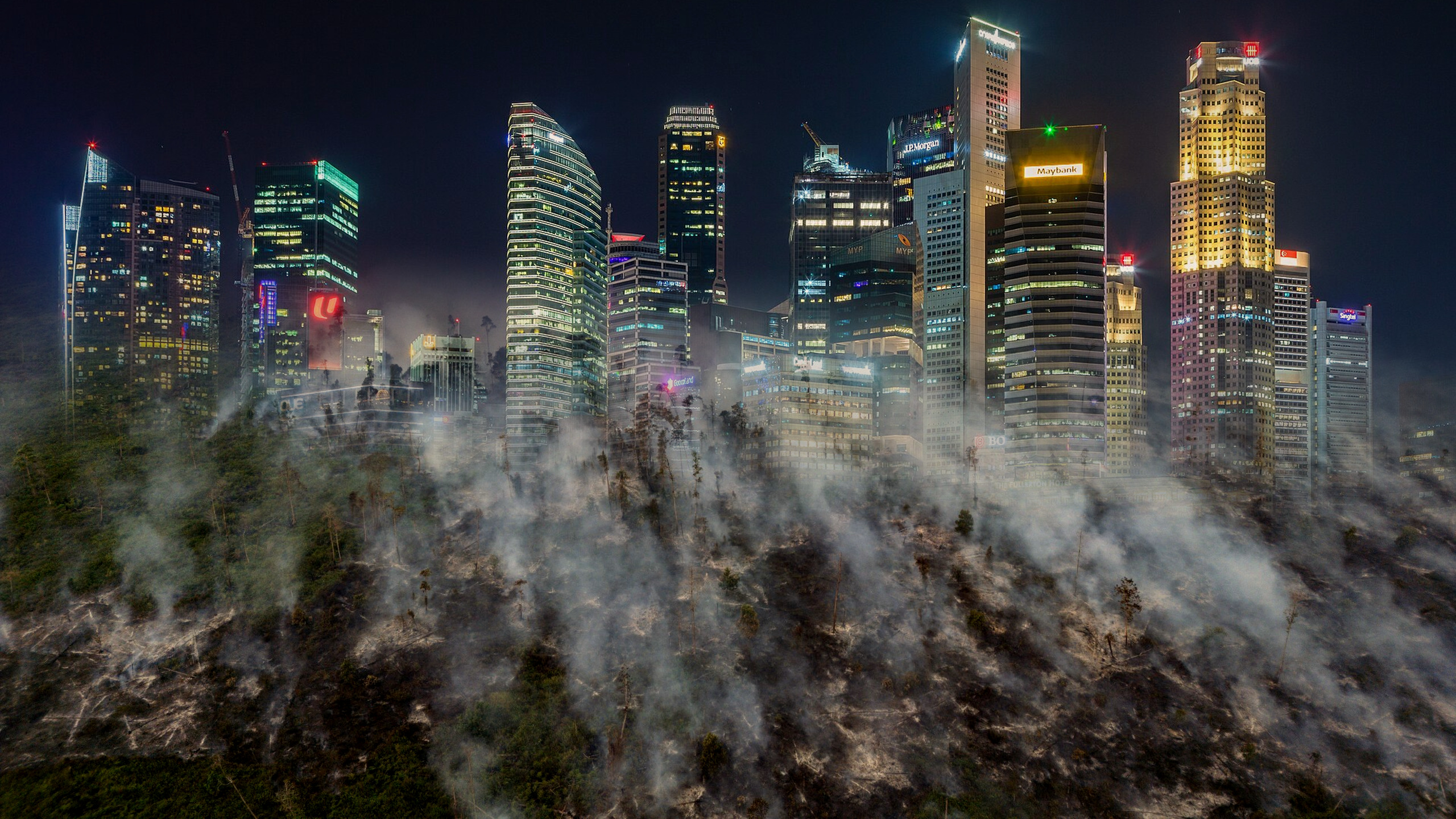
 AI generated illustration of toxic haze reaching the financial district of Singapore
Connecting the Banks and Investors linked to Indonesia’s fires and haze crisis
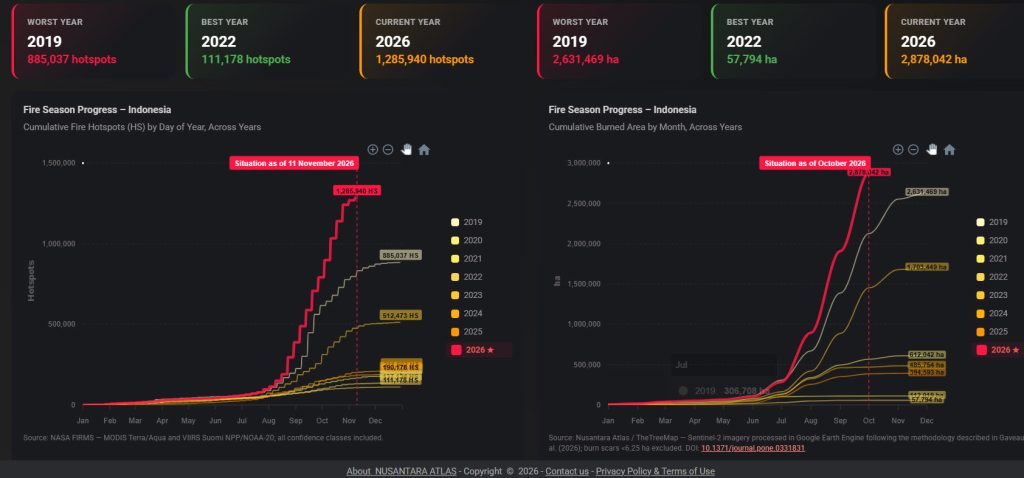
AI generated illustration of toxic haze reaching the financial district of Singapore Indonesia is once again experiencing a severe fire season. Data from Nusantara Atlas’s FireWatch indicate that 2026 has become the worst year in its burned-area monitoring record, since monitoring began in 2019. An estimated 2.88 million hectares burned across Indonesia between January and October 2026, already exceeding the 2.63 million hectares recorded for all of 2019, the previous record year
Nearly two-thirds of the mapped burned area was detected in the last two months (September and October). This January–October 2026 estimate is 35% higher than during the same period in 2019. By 11 November, cumulative satellite hotspot detections were also 67% higher than during the same period in 2019. These comparisons use the same satellites and same methodology across all years in the monitoring period, avoiding an artificial increase caused by adding sensors. Based on the impacts in previous years, the economic damage losses in Indonesia, Malaysia and Singapore are estimated to run into billions of dollars.1
These burned-area estimates are conservative for three reasons. First, we exclude individual burn scars smaller than 6.25 hectares. Second, we prioritise avoiding false detections. Third, heavy smoke has at times obscured satellite imagery, limiting our ability to detect burned areas.
The ‘super’ El Niño has made conditions drier, but vast areas of Indonesia’s lowlands became flammable mainly because palm oil and pulpwood plantations spent years clearing and draining peatlands.
When healthy, these peat-swamp forest ecosystems are waterlogged and naturally fire-resistant. Clearing and draining them for plantations dries out carbon-rich soil that took millennia to build up. Once that soil ignites, it can burn and spread deep underground, smouldering for weeks and giving off toxic haze which then spreads across the region.
These fires are highly predictable, a recurring result of Indonesia’s plantation sector and the financial sector that drives it. Banks and investors have financed this process for decades. Short-term profits have been captured by the shareholders of these companies and their financiers. The long-term costs now fall on the public in Indonesia and its neighbours, through chronic air pollution and respiratory health problems, habitat destruction, economic loss and damage, and enormous carbon emissions. None of these so-called externalities appear to be priced into financial decisions of major banks and investors.
Where does finance fit ?
Like the haze, the finance driving it is also transboundary. Many of the companies linked to fires and haze are publicly listed or headquartered in Singapore or Malaysia, and are often financed by banks and investors there. Profits from companies driving Indonesia’s environmental ruin often flow out of Indonesia through these regional financial centres.
The financial sectors of Indonesia, Malaysia and Singapore are exposed to the crisis, and all three can, and must act on it.
Lenders and investors can dramatically shift the economic incentives forof companies and supply chains operating in these fire-risk landscapes. They can set conditions on new and existing financing, and monitor client performance across their plantation portfolios at scale, using satellite data and other forms of due diligence, and promote responsible business practices with clear consequences for non-compliance.
Global commodity traders and consumer goods companies already run grievance tracking and monitoring systems for their supply chains. Financial institutions have typically pushed back against the proactive monitoring of client impacts saying they do not have the expertise, or that it is impractical or too expensive.
However, this is not the case. Financial institutions are sophisticated and well resourced. Satellite data tracking forest loss, peatland conversion and fires are publicly available. Land-use data, combined with concession maps provide a wealth of information that can be used to monitor clients at scale and in near real-time can alert financial institutions to the impacts of their portfolio.
To demonstrate this, The TreeMap and the Forests & Finance coalition are, over the coming months, integrating our datasets – spatial data on fires, burn scars and deforestation, with Forests & Finance’s data on loans, underwriting and investment. The resulting data tool will be open-source and enable users to:
- identify the lenders and investors linked to concessions with burn scars or in high fire-risk areas
- measure total burned area across a financial institution’s identified plantation portfolio
- rank financial institutions by their exposure to clients with burn scars in their concessions
- identify the financiers of companies opening new areas of peatland and forest, adding to the fire risk
The tool is built entirely on public data, and on a budget that is a rounding error next to a bank executive’s pay package.
How the tool works ?
The tool links concessions (e.g. palm oil or pulpwood) and facilities (mills, refineries) to the companies that hold them, and from there to the financing those companies received. Most financing goes to a parent company or operating group rather than the specific subsidiary that holds the concession. A public methodology will follow the ownership chain and assign that financial attribution accordingly.
A burn scar within a concession shows that land burned; it does not establish who started the fire. Plantation companies have used fire, directly or through third parties, to clear land cheaply. However, fires can also start accidentally within concessions or arise from land conflicts with communities. Fires may also spread into concessions from outside, following land clearing by farmers or absentee landowners, or activities by fishers, hunters, and miners. On dry peat and in dried-out swamps, fires can spread uncontrollably, regardless of who ignited them. Draining peat for oil palm and pulpwood plantations increases this risk.
In all cases, a burn scar inside or near a concession signals material risk. It shows that the company operates in a fire-prone landscape, has weak fire prevention and/or response, or both.
Indonesian law has provisions that can hold companies liable for fires on their land whoever started them. The 2014 Plantation Law requires concession holders to maintain fire-prevention and fire-control systems.2 The 2009 Environmental Protection and Management Law imposes strict liability for environmental damage.3 While every fire that occurs within a company’s concession is the absolute responsibility of the Company, Presidential Instruction No. 11 of 2026 goes further in an effort to implement the precautionary principle. It directs government authorities to develop policies that hold concession holders responsible for a buffer zone of at least 5 km around their concessions. Therefore Companies must implement fire mitigation measures outside their concession boundaries with particular attention to communities.
What can financial regulators do?
Indonesia, Malaysia, Singapore, Japan and China all adopted the Kunming-Montreal Global Biodiversity Framework (GBF) in 2022, in which governments committed to “progressively aligning all relevant public and private activities, fiscal and financial flows” with the framework’s goals. Under Target 15, they committed to requiring large companies and financial institutions to monitor, assess and disclose their impacts on biodiversity, including across their portfolios. Governments met in Yerevan last month for COP17 to review progress.
Financing for peatland plantations in Indonesia is an obvious example of harmful financial flows and a clear test of whether the GBF commitments mean anything. Draining peat for plantations destroys some of the most biodiverse and carbon-dense ecosystems on earth. It fuels fires and haze that damage public health across three countries – undermining the right to a clean, healthy and sustainable environment.4 After fires, plantation companies often abandon the burned land, which remains fire-prone without restoration. A single loan can do damage on every axis the GBF is meant to address.
A new report by The Forests & Finance Coalition highlights significant gaps in financial regulations in Indonesia, Singapore, Malaysia, Japan and China. It finds that existing frameworks do not provide adequate safeguards to prevent financial institutions from financing companies involved in deforestation and natural ecosystem conversion, including potentially harmful activities affecting peatland ecosystems.
The Singapore-Asia Taxonomy explicitly recognises the impacts of peat fires and includes no-conversion criteria for sensitive habitats, including peatlands and wetlands, but only applies it to forestry and not palm oil or other agriculture- and it is only voluntary at the moment.5 In response to this year’s fires, on 28 October 2026, the Monetary Authority of Singapore reinforced its expectations that banks should assess clients linked to haze-causing activities and take stronger measures, including restricting financing or exiting relationships in cases where environmental laws are clearly breached.6 Implementing these expectations and mandating alignment with sustainable taxonomies could be a powerful step towards tackling the root cause of the fire and haze crisis.
What can financial institutions do?
Lenders and investors acting decisively and responsibly, especially when there is clear regulation, have enormous leverage. It is crucial for both to advance efforts to curb the excessive harmful flows in parallel, not waiting for others to make a first move.
Before financing, financial institutions should screen a client’s entire corporate group7 and supply base for fire risk, not just the entity taking the loan. That means checking every concession and mill under common ownership, including opaque affiliates, against burn scars, peat degradation and planting, and recent deforestation.
In loan agreements, they should require clients to provide concession boundary maps. Covenants should prohibit draining new peatland and planting commercial crops on burned land. Burning is the cheapest way to clear land for planting, so if burned land cannot be planted, the incentive to burn disappears. A breach should be treated as a default event entitling lenders to accelerate loan repayment.
During the financing term, they should monitor deforestation, peatland expansion, fire hotspots and burn scars across client concessions and the 5 km buffer zone under Presidential Instruction No. 11 of 2026. In cases of non-compliance, financial institutions should set out a transparent protocol in advance which may include engagement and a time-bound corrective action plan, but must have clear consequences including a termination threshold if issues remain unresolved.
Positive incentives are also an important tool. Lenders can offer margin reductions, as in sustainability-linked loans, tied to verified targets such as zero new burn scars, or hectares of peat retired from production and restored.
Underpinning all of this is careful restoration. Abandoning failed plantations on peat is no solution, because unmanaged drained peatlands are a major source of fire. Rewetting and restoring Indonesia’s degraded peatlands is an enormous undertaking. Shifting finance away from peat destruction and toward the community and government efforts to rewet and restore it is what alignment with the GBF looks like in practice.
While the tool is in development, the examples below show how the data will come together:
Note: At the time of publication, individual data on burned area on peatlands and within the 5km buffer zone of concessions was not available and so burn scar data shown below cover Jan-September 2026)
Case 1. PT Kayung Agro Lestari > First Resources > Fangiono Group
– Concession / Location: PT Kayung Agro Lestari (KAL) / Ketapang, West Kalimantan
– Commodity: Oil Palm
– Sub-Group: First Resources
– Relationship: Formal ownership
– Parent Group: Fangiono Group
Burn Scar & Environmental Impact:
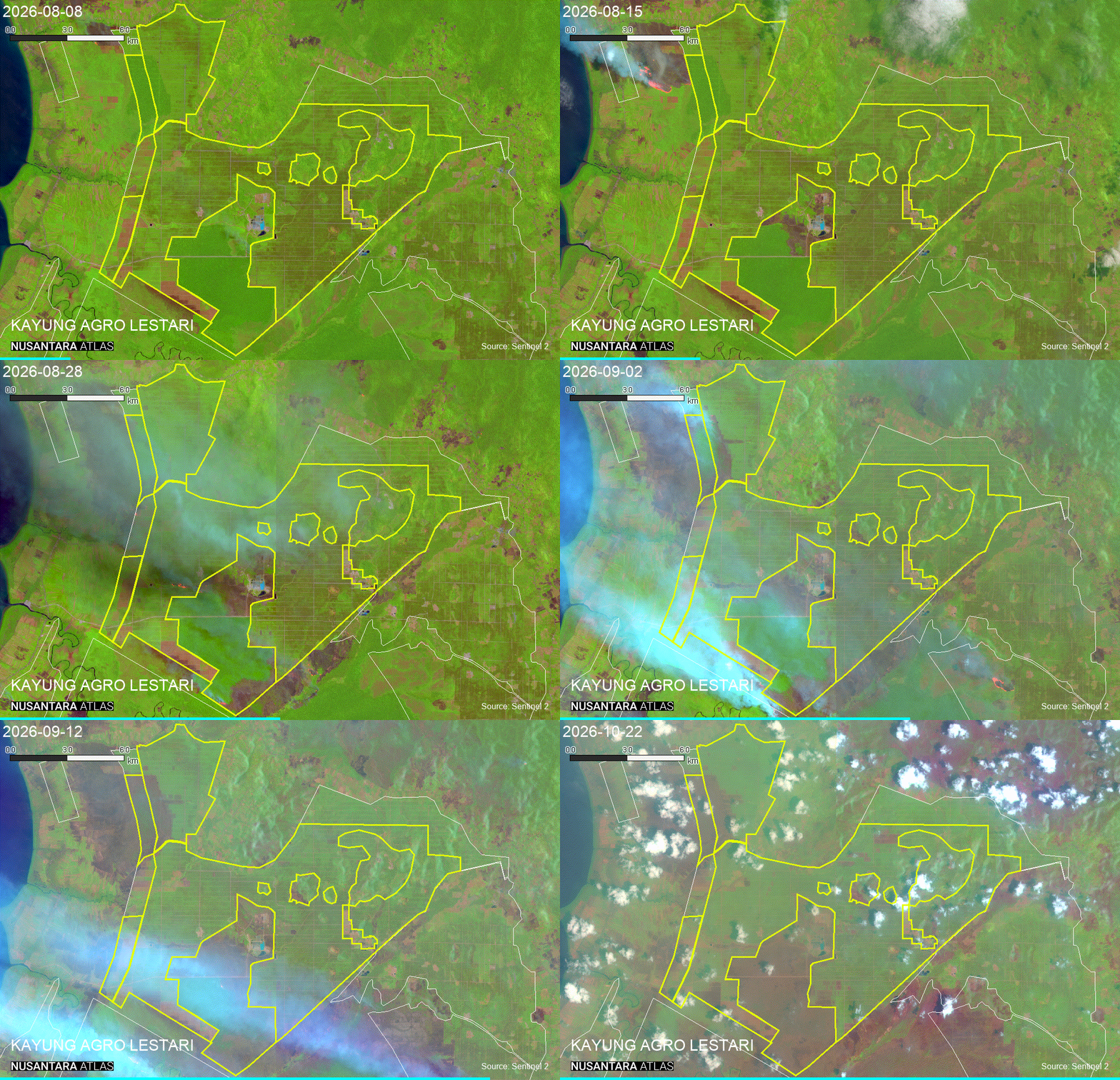
At least 3,742 hectares have burned from January to September 2026 in the concession, with 3,016 hectares on peatlands (around 80%), and 1,969 ha of the burned land was High Conservation Value (HCV) forest. Over the same period, there were extensive burned areas totalling 17,553 ha within the 5 km buffer of PT KAL borders, the zone for fire mitigation according to fire mitigation according to Presidential Instruction No 11/2026.
Nusantara Atlas map showing burned area (January-September) in red in PT Kayung Agro Lestari. Company boundaries in turquoise.
In response to these findings, First Resources stated that they observe a strict Zero Burning Policy and implement an Integrated Fire Management initiative, and there may be instances where fires spread from outside into PT KAL concession. They further stated that the 5km buffer referred to in Presidential Instruction No 11/2026 “primarily functions as an executive directive from the President to government officials rather than a statute that directly binds the general public” and that the buffer area around PT KAL is “managed by local communities, other companies, and the government. Therefore, the presence of burned areas within this buffer should not, in itself, be interpreted as evidence of … responsibility for those fires“.
The HCV area was previously managed by Austindo Nusantara Jaya (ANJ), and had been used as peat forest for displaced orangutans.8 Following the acquisition of ANJ, it has been reported that First Resources retrenched many sustainability staff managing the HCV areas and with knowledge of fire fighting, and also ceased cash payments to local villages for fire-free practices.9 This has also been outlined in in a complaint to the Roundtable on Sustainable Palm Oil (RSPO) submitted against First Resources in October 2026.10
On 9th October 2026, an Indonesian government team entered PT KAL’s HCV area and found what appears to be the skull of a dead Borneon Orangutan. With the Director General of Forest Law Enforcement stating that that the Ministry of Forestry “Plantation concessions that have HCV acreage bear the legal and moral responsibility to maintain wildlife corridors in their area.”11
Financing:
First Resources Ltd is a Singapore headquartered and listed company (SGX:EB5) controlled by the Fangiono family. Its CEO Ciliandra Fangiono is reportedly domiciled in Singapore and has become a Singapore citizen.12 From 2019 to September 2026, First Resources has been financed by syndicated loans totalling US$ 450 million with the largest creditors being Singapore banks DBS and UOB, and Japanese bank SMBC Group contributing US $137.5 million each. Maybank contributed $37.5 million.
ANJ, prior to its acquisition by First Resources also received credit and underwriting totalling US $ 1.6 billion (2019-Sept 2026), with the largest contributors being again being Singapore bank OCBC ($617 million), Indonesian bank BRI $289 million and Malaysian bank CIMB ($180 million).
Financiers linked to PT. Kayung Agro Lestari
Sub-GroupFirst Resources$✓
| Financier | US$ m |
|---|---|
| Austindo Nusantara Jaya | 1,165.0 |
| OCBC | 653.7 |
| Bank Rakyat Indonesia | 289.5 |
| CIMB Group | 180.5 |
| SMBC Group | 37.8 |
| UOB | 3.5 |
| First Resources | 450.0 |
| UOB | 137.5 |
| SMBC Group | 137.5 |
| DBS | 137.5 |
| Maybank | 37.5 |
Parent GroupFangiono Group$✓
| Financier | US$ m |
|---|---|
| Fangiono Agro Plantation (FAP Agri) | 613.7 |
| Bank Central Asia | 613.7 |
| First Resources shown above | 1,615.0 |
$✓ financing data recorded at this level · $✗ no data · fire-linked concession · Source: Forests & Finance
Sub-GroupFirst Resources$✓
| Investor | US$ m |
|---|---|
| King Fortune Trust | 330.2 |
| Amova Asset Management | 71.5 |
| American Century Investments | 58.8 |
| Vanguard | 50.2 |
| Fidelity International | 36.7 |
| Dimensional Fund Advisors | 36.0 |
| Schroders | 30.0 |
| BlackRock | 29.6 |
| Lazard | 16.2 |
| Allianz | 13.8 |
| CI Financial | 12.8 |
| Bank of New York Mellon | 11.5 |
| Danske Bank | 10.3 |
| Northern Trust | 8.4 |
| Affiliated Managers Group | 8.2 |
| Fidelity Investments | 5.4 |
| OCBC | 5.0 |
| Bessemer Group | 5.0 |
| UOB | 5.0 |
| JPMorgan Chase | 4.9 |
Parent GroupFangiono Group$✓
| Investor | US$ m |
|---|---|
| First Resources shown above | 749.2 |
$✓ financing data recorded at this level · $✗ no data · fire-linked concession · Source: Forests & Finance
Case 2: PT Damai Agro Sejahtera > Bumitama Agri > Harita Group
– Entity / Location: PT Damai Agro Sejahtera (DAS) / Ketapang, West Kalimantan
– Commodity: Oil Palm
– Sub-Group: Bumitama Agri
– Relationship: Formal ownership
– Parent Group: Harita Group
Burn Scar & Environmental Impact:
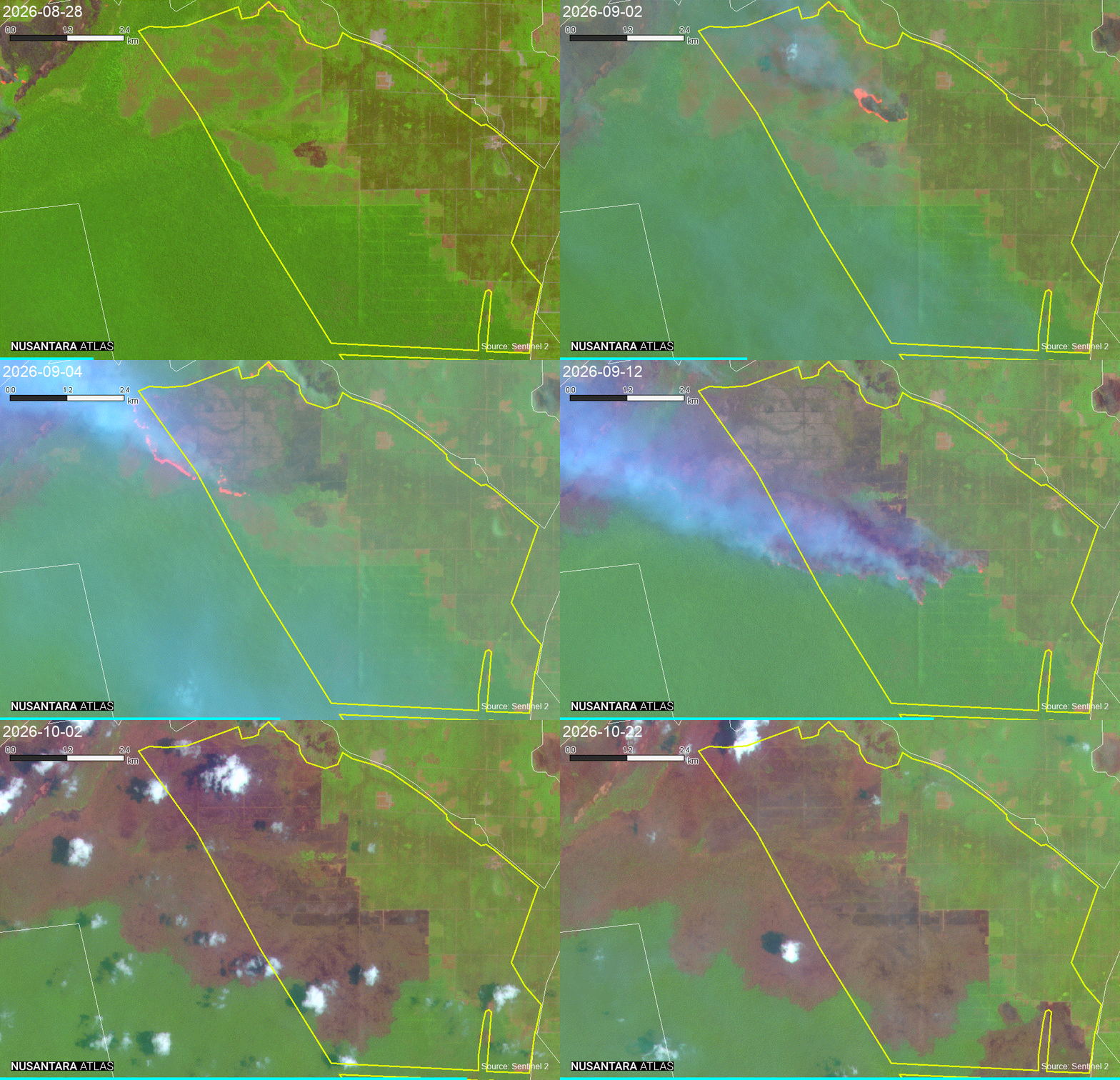
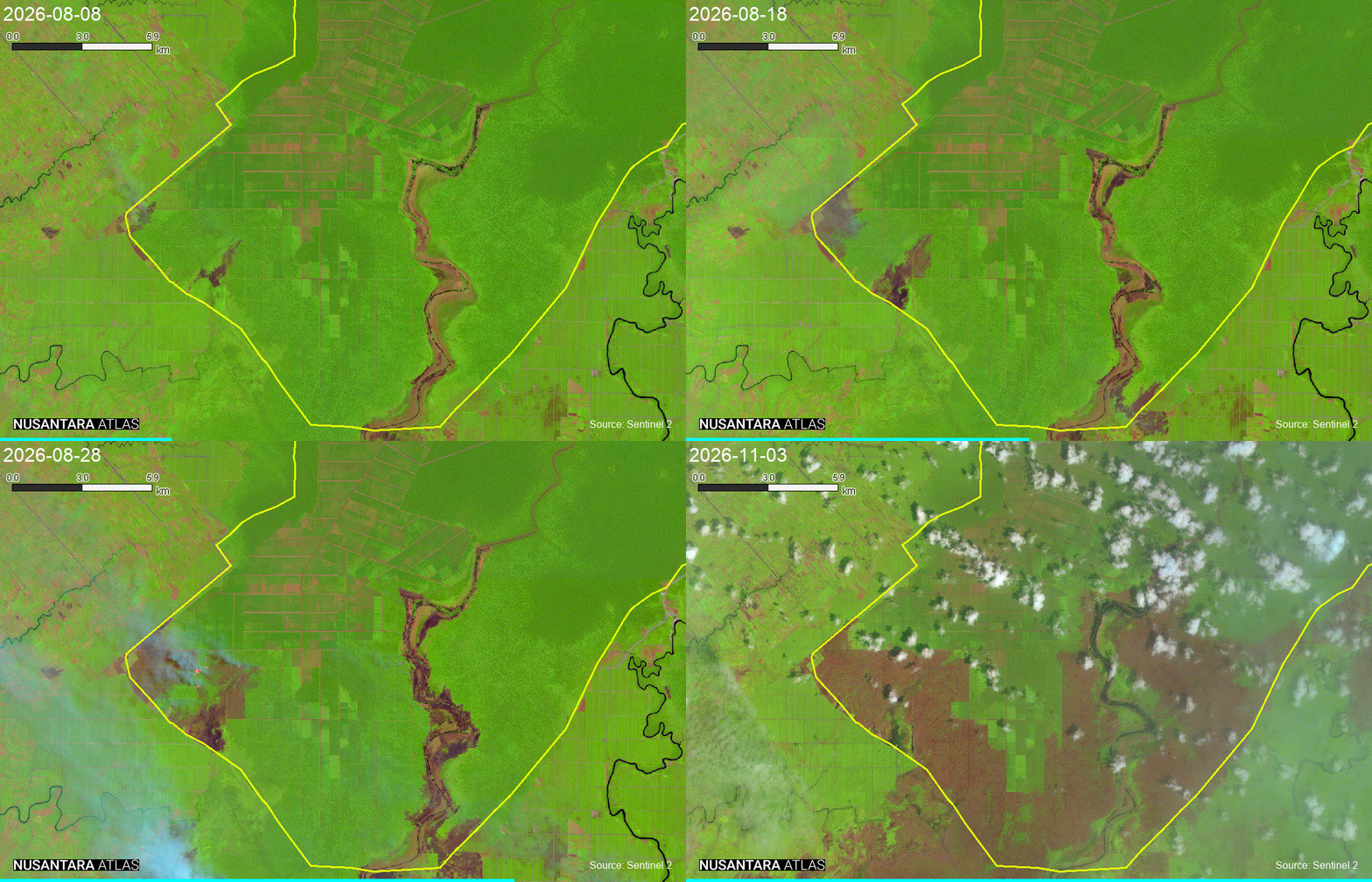
Satellite analysis shows cumulative burn scars covering 4,473 hectares of PT DAS concession, with 88% of this (3,925 hectares) burning on peatlands from January to September 2026. Additionally, 7,247 hectares burned, including 3,158 hectares on peat within the 5km buffer of the PT DAS concession under Presidential instruction no 11.2026. Satellite imagery appears to show an ignition point inside PT DAS concession 2nd September 2026 (see below).
Nusantara Atlas map showing burned area (January-September) in red in PT Damai Agro Sejahtera. Company boundaries in yellow.
RAN presented these findings to Bumitama, who replied that “as the relevant authorities are currently assessing matters relating to the recent fires, and a fact-finding process remains ongoing…we are not in a position to comment”. The company referred RAN to their announcement to the Singapore Stock Exchange.
Financing:
PT DAS is a subsidiary of Singapore-listed Bumitama Agri Tbk13, an oil palm division of Harita Group, controlled by the Lim family. Forests & Finance data reveals that Bumitama has received USD 344 million in credit and underwriting since 2019, with $137.5 coming from Singapore banks UOB, OCBC and DBS. Maybank is Bumitama’s largest creditor with loans of $169 million and Japanese bank SMBC contributing $37.5.
Financiers linked to PT. Damai Agro Sejahtera
Sub-GroupBumitama Agri$✓
| Financier | US$ m |
|---|---|
| Maybank | 169.2 |
| UOB | 62.5 |
| SMBC Group | 37.5 |
| DBS | 37.5 |
| OCBC | 37.5 |
Parent GroupHarita Group$✓
| Financier | US$ m |
|---|---|
| Bumitama Agri shown above | 344.2 |
$✓ financing data recorded at this level · $✗ no data · fire-linked concession · Source: Forests & Finance
Sub-GroupBumitama Agri$✓
| Investor | US$ m |
|---|---|
| Goldman Sachs | 19.4 |
| American Century Investments | 18.4 |
| Vanguard | 15.1 |
| Fidelity International | 12.6 |
| Bank of New York Mellon | 7.1 |
| OCBC | 4.9 |
| BlackRock | 2.9 |
| aberdeen | 2.7 |
| Banca Monte dei Paschi di Siena | 2.6 |
| Florida State Board of Administration (FSBA) | 1.5 |
| State Street | 1.3 |
| UOB | 1.1 |
| Charles Schwab | 1.0 |
| Scotiabank | 1.0 |
| Manulife Financial | 0.6 |
| UBS | 0.6 |
| BrightSphere Investment Group | 0.6 |
| Lazard | 0.6 |
| CI Financial | 0.4 |
| Deutsche Bank | 0.4 |
Parent GroupHarita Group$✓
| Investor | US$ m |
|---|---|
| Bumitama Agri shown above | 94.7 |
$✓ financing data recorded at this level · $✗ no data · fire-linked concession · Source: Forests & Finance
Case 3: PT Mayawana Persada > Green Ascent (M) Sdn Bhd > Royal Golden Eagle Group
– Entity / Location: PT Mayawana Persada (MP) / Kayong Utara, West Kalimantan
– Commodity: Pulpwood
– Sub-Group: Green Ascend (M) Sdn Bhd
– Relationship: Supplier, Shadow Company
– Parent Group: Royal Golden Eagle
Burn Scar & Environmental Impact:
PT Mayawana Persada ranks among the largest single sources of deforestation across Indonesia’s entire plantation sector, having cleared more than 38,000 hectares since between 2021-23 including nearly 22,000 ha of peatforests.14 In 2024, the Indonesian Ministry of Environment and Forestry ordered PT MP to stop logging in its concession and to restore degraded peatlands.15 The company reportedly defied this government order and began planting commercial acacia on the peatland areas.16
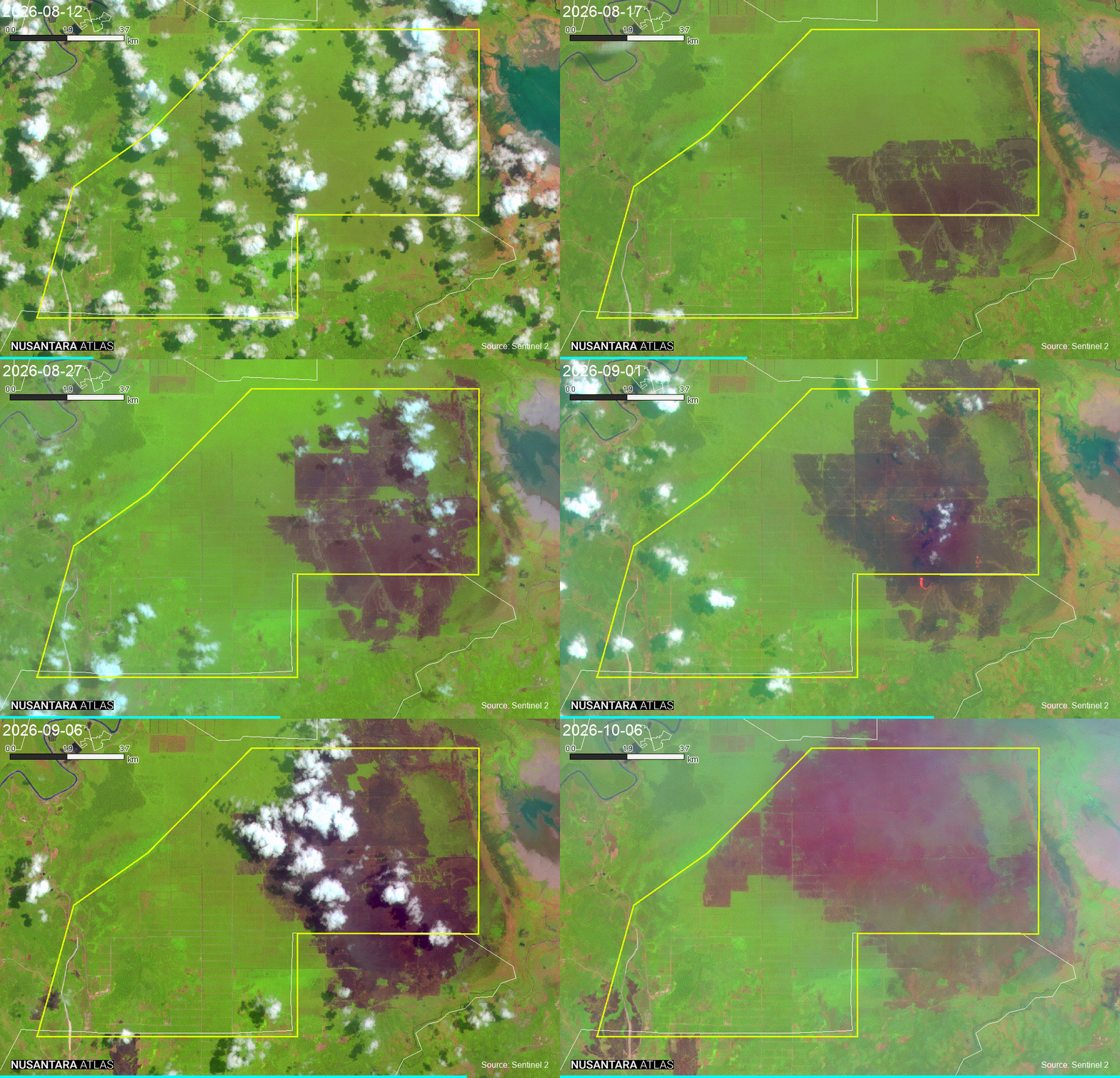
Burnscar analysis shows cumulative burned areas totalling 11,065 hectares within the pulpwood concession of PT MP from January to September 2026, with around 65% of this burning on peatlands (7,158 hectares). A further 8,773 hectares has burned, including 4,230 hectares on peat within the 5km buffer of PT MP’s concession.
Nusantara Atlas map showing burned area (January-September) in red in PT Mayawana Persada. Company boundaries in turquoise.
Financing:
In 2025, Greenpeace report published extensive evidence alleging Royal Golden Eagle (RGE) control of PT MP as a shadow company held through Malaysian holding company Green Ascend.17 In 2026, Royal Golden Eagle’s flagship pulpwood company APRIL stated that it would start sourcing from PT MP as an approved list of suppliers.18
As a privately held shadow company, Forests & Finance has no direct financing data for PT MPMayawana Persada itself or its immediate owner Sub-Group Green Ascend (M) Sdn Bhd. The only available financing data is at the parent group level, for RGE group. Therefore, the closest our financing will methodology therefore will reretrieve revert to financing data forat the parent group inlevel for the sector commodity in question, so all pulp financing to RGE .in this instance, Royal Golden Eagle pulpwood financing.
RGE’s company APRIL forwarded our allegations to PT MP for a response, which replied that they have “a No Burn policy. Any fire incidents are reported to the relevant authorities. We do not confirm the fire data provided by RAN”. In previous communications, RGE has denied that PT MP is a shadow company.19
Overall, RGE has received just over USD 10 billion in credit for its pulp operations since 2019. Some of the largest financiers are Chinese, Bank of China ($731 million), CITIC ($674 million), China Minsheng Bank ($588 million). Other major backers include Brazilian banks Bradesco, BTG Pactual, and Itau Unibanco.
Financiers linked to PT. Mayawana Persada
Parent GroupRoyal Golden Eagle Group$✓
| Financier | US$ m |
|---|---|
| Asia Pacific Resources International (APRIL) | 6,287.8 |
| APRIL Fine Paper Trading (Middle East) | APRIL International Enterprise | 1,549.0 |
| SinoPac Holdings | 60.9 |
| Industrial Bank Company | 60.9 |
| First Financial Holding | 60.9 |
| Banco Bilbao Vizcaya Argentaria (BBVA) | 60.9 |
| National Bank of Kuwait | 60.9 |
| Bank of China | 60.9 |
| DZ Bank | 60.9 |
| Bank of Communications | 60.9 |
| Xiamen International Bank | 60.9 |
| China Construction Bank | 60.9 |
| Mitsubishi UFJ Financial | 60.9 |
| China Merchants Bank | 60.9 |
| Shanghai Pudong Development Bank | 60.9 |
| China Minsheng Banking | 60.9 |
| SMBC Group | 60.9 |
| CITIC | 60.9 |
| Fubon Financial | 60.9 |
| Taiwan Financial Holding | 46.8 |
| Taiwan Business Bank | 23.4 |
| Export-Import Bank of the Republic of China | 23.4 |
| Ping An Insurance Group | 23.4 |
| Hua Xia Bank | 23.4 |
| State Bank of India | 23.4 |
| China Bohai Bank | 23.4 |
| Cathay General Bancorp | 23.4 |
| Kasikornbank | 23.4 |
| E.SUN Financial | 23.4 |
| Kiatnakin Phatra Financial Group | 23.4 |
| China Eximbank | 23.4 |
| Krung Thai Bank | 23.4 |
| Taichung Commercial Bank | 23.4 |
| Mega Financial | 23.4 |
| Yuanta Financial | 23.4 |
| Taiwan Cooperative Financial | 23.4 |
| China Cinda | 23.4 |
| Bank of Shanghai | 23.4 |
| Arab Bank | 23.4 |
| Hua Nan Financial | 23.4 |
| Asia Pacific Rayon | 300.0 |
| Bank Panin | 60.0 |
| Bank Rakyat Indonesia | 60.0 |
| Bank Central Asia | 60.0 |
| Hana Financial | 40.0 |
| Woori Financial | 40.0 |
| Bank Pembangunan Daerah – Danten | 40.0 |
| Asia Pacific Resources International | 3,900.2 |
| CITIC | 613.3 |
| Bank of China | 299.8 |
| Taiwan Financial Holding | 299.7 |
| Mitsubishi UFJ Financial | 221.7 |
| Taiwan Business Bank | 204.8 |
| China Minsheng Banking | 191.6 |
| China Construction Bank | 181.8 |
| Shanghai Pudong Development Bank | 170.2 |
| E.SUN Financial | 166.6 |
| Hua Nan Financial | 136.7 |
| National Bank of Kuwait | 131.7 |
| Industrial Bank Company | 131.7 |
| China Merchants Bank | 115.1 |
| Bank of Communications | 105.1 |
| China Cinda | 105.0 |
| Mega Financial | 95.0 |
| State Bank of India | 90.0 |
| Banque Misr | 75.0 |
| ABN Amro | 60.0 |
| First Financial Holding | 45.1 |
| Xiamen International Bank | 45.0 |
| Taishin Financial Group | 45.0 |
| Taiwan Cooperative Financial | 40.0 |
| Kasikornbank | 30.1 |
| Bank of Shanghai | 30.0 |
| Chang Hwa Commercial Bank | 30.0 |
| Arab Banking Corporation (Bank ABC) | 25.0 |
| Arab Bank | 25.0 |
| Commercial Bank International | 25.0 |
| Commercial Bank of Dubai | 25.0 |
| Intesa Sanpaolo | 25.0 |
| Bank of East Asia | 20.0 |
| Fubon Financial | 20.0 |
| Yuanta Financial | 20.0 |
| SinoPac Holdings | 15.0 |
| Shinhan Financial Group | 15.0 |
| Entie Commercial Bank | 10.0 |
| UBS | 10.0 |
| Bank of Panhsin | 5.0 |
| Riau Andalan Paperboard International | 538.7 |
| Bank of China | 150.0 |
| China Eximbank | 119.0 |
| Bank Central Asia | 105.5 |
| Bank Panin | 49.3 |
| CT Corpora | 42.2 |
| China Minsheng Banking | 41.0 |
| Bank Pembangunan Daerah – Sumatera Selatan | 17.6 |
| Industrial Bank of Korea | 14.1 |
| Bracell | 2,323.0 |
| Bracell | 306.3 |
| BTG Pactual | 306.3 |
| Bracell Bahia Specialty Cellulose | 216.7 |
| BTG Pactual | 75.0 |
| Itaú Unibanco | 75.0 |
| Taishin Financial Group | 33.3 |
| SinoPac Holdings | 33.3 |
| Bracell International | 1,800.0 |
| Bradesco | 509.1 |
| China Minsheng Banking | 215.1 |
| Safra Group | 215.1 |
| Itaú Unibanco | 215.1 |
| Bank of China | 215.1 |
| Banco Latinoamericano de Comercio Exterior | 215.1 |
| Banco do Brasil | 215.1 |
| Royal Golden Eagle Group | 1,427.3 |
| DSP Cellulose Trading FZCO | Royal Golden Eagle | SPS Cellulose Trading | 1,422.1 |
| Taishin Financial Group | 79.7 |
| Mega Financial | 79.7 |
| Banco Bilbao Vizcaya Argentaria (BBVA) | 79.7 |
| Banco do Brasil | 79.7 |
| Shanghai Pudong Development Bank | 79.7 |
| Bank of Communications | 79.7 |
| First Financial Holding | 79.7 |
| Bradesco | 79.7 |
| Itaú Unibanco | 79.7 |
| BTG Pactual | 79.7 |
| Mitsubishi UFJ Financial | 79.7 |
| Chang Hwa Commercial Bank | 79.7 |
| SinoPac Holdings | 79.7 |
| China Minsheng Banking | 79.7 |
| Xiamen International Bank | 79.7 |
| E.SUN Financial | 79.7 |
| Industrial Bank Company | 79.7 |
| Postal Savings Bank of China | 33.6 |
| Ping An Insurance Group | 33.6 |
| Royal Golden Eagle Group | 5.2 |
| Bank of China | 5.2 |
No financing is recorded for PT. Mayawana Persada or Green Ascend. The parent group figures are Royal Golden Eagle’s pulp & paper financing.
$✓ financing data recorded at this level · $✗ no data · fire-linked concession · Source: Forests & Finance
Parent GroupRoyal Golden Eagle Group$✓
| Investor | US$ m |
|---|---|
| Asia Pacific Resources International (APRIL) | 0.1 |
| Massachusetts Pension Reserves Investments Management | 0.1 |
$✓ financing data recorded at this level · $✗ no data · fire-linked concession · Source: Forests & Finance
Case 4: London Sumatra Indonesia > First Pacific > Salim Group
– Entity / Location: PP London Sumtara Indonesia (Isuy Makmur Estate) / Kutai Barat, East Kalimantan
– Commodity: Oil Palm
– Sub-Group: First Pacific
– Relationship: Formal Ownership
– Parent Group: Salim Group
Burn Scar & Environmental Impact:
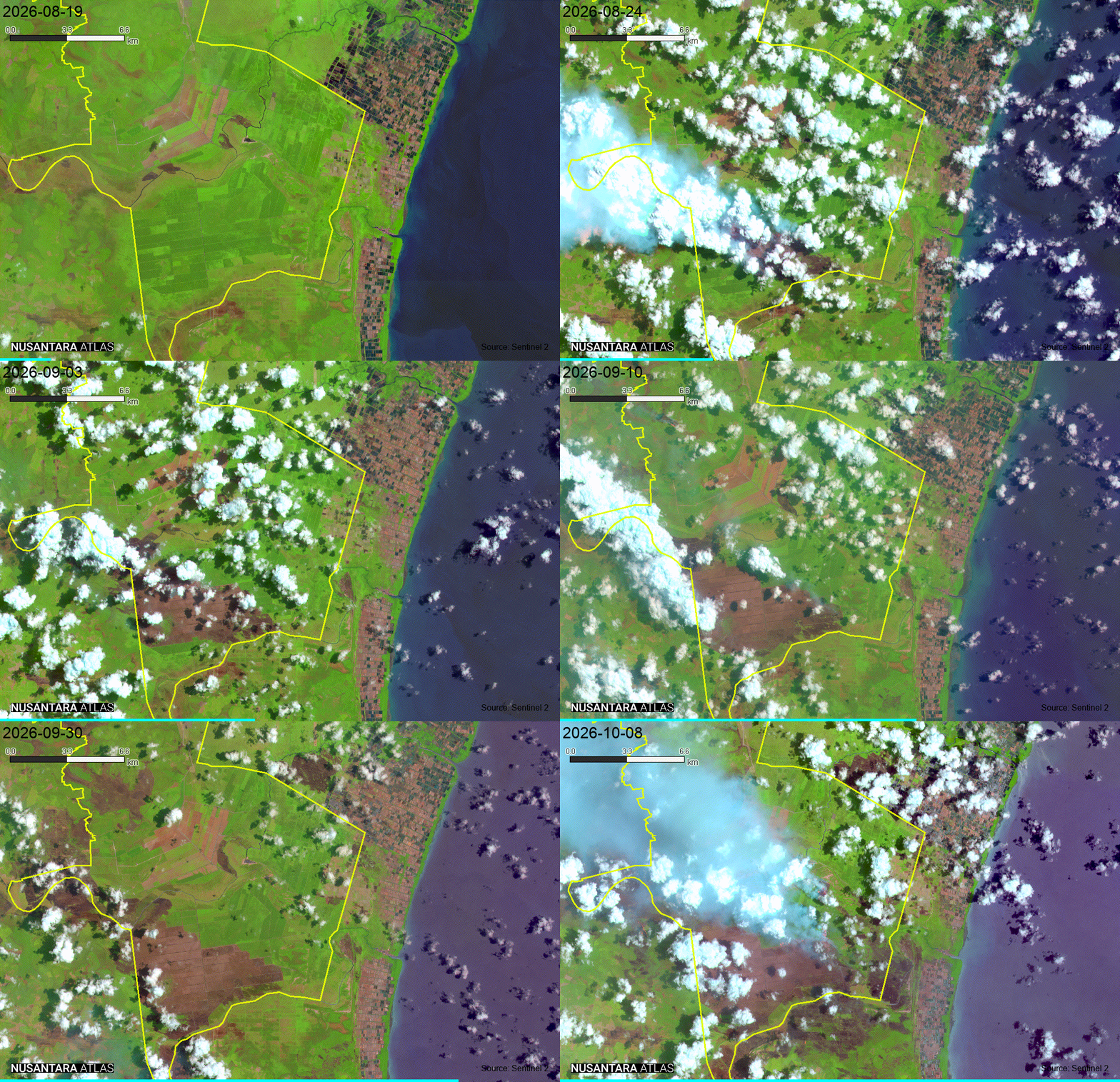
Burnscar analysis shows cumulative burned areas totalling 4,189 hectares within the boundaries of Isuy Makmur estate from January to September 2026. A further 877 hectares has burned within the mandated 5km buffer Isuy Makmur concession. RAN presented this analysis to Salim Group but did not receive a response.
Nusantara Atlas map showing burned area (January-September) in red in Isuy Makmur Estate of PP London Sumatra Indonesia. Company boundaries in turquoise. The planted oil palm estate is in khaki green.
Financing:
Salim Group, the ultimate parent of PP London Sumatra Indonesia Tbk (Lonsum) has a particularly convoluted ownership structure and financing is received at multiple levels in this ownership structure. Lonsum is majority owned via several ownership layers including Indofood companies by First Pacific Company Ltd. This is the Hong Kong incorporated investment group controlled by Indonesian tycoon Anthoni Salim.20
The largest overall creditors between 2019 and September 2026 are Indonesian banks Bank Central Asia ($1 billion) and Bank Mandiri ($711 million), followed by DBS ($322 million), and Japanese banks SMBC Group ($314 million), Mizuho Financial ($252 million) and Mitsubishi UFG financial ($197 million). Of these six banks, all except Bank Mandiri have NDPE-aligned policies.
Financiers linked to Isuy Makmur Estate
Sub-GroupFirst Pacific$✓
| Financier | US$ m |
|---|---|
| FP Treasury (2022) | 15.8 |
| HSBC | 1.6 |
| CITIC | 1.6 |
| Taiwan Financial Holding | 1.3 |
| Bank of East Asia | 0.8 |
| China Cinda | 0.8 |
| Cathay Financial | 0.8 |
| National Bank of Kuwait | 0.8 |
| Mitsubishi UFJ Financial | 0.8 |
| Chang Hwa Commercial Bank | 0.8 |
| E.SUN Financial | 0.8 |
| CTBC Financial Holding | 0.8 |
| Hua Nan Financial | 0.8 |
| SinoPac Holdings | 0.7 |
| Taiwan Cooperative Financial | 0.7 |
| Mega Financial | 0.7 |
| First Financial Holding | 0.6 |
| Taiwan Business Bank | 0.6 |
| Taichung Commercial Bank | 0.6 |
| Shanghai Commercial & Savings Bank | 0.5 |
| FP Treasury (2024) | 16.5 |
| Mizuho Financial | 1.2 |
| Mitsubishi UFJ Financial | 1.2 |
| CITIC | 1.2 |
| HSBC | 1.2 |
| Taiwan Financial Holding | 1.1 |
| Bank of East Asia | 1.0 |
| Hua Nan Financial | 1.0 |
| Chiba Bank | 0.8 |
| Taishin Financial Group | 0.5 |
| Shin Kong Financial Holding | 0.5 |
| First Financial Holding | 0.5 |
| DBS | 0.5 |
| Fubon Financial | 0.5 |
| Shanghai Commercial & Savings Bank | 0.5 |
| Cathay Financial | 0.5 |
| SinoPac Holdings | 0.5 |
| Taiwan Cooperative Financial | 0.5 |
| Taiwan Business Bank | 0.5 |
| Dah Sing Financial | 0.5 |
| Chang Hwa Commercial Bank | 0.5 |
| China Cinda | 0.5 |
| Mega Financial | 0.5 |
| FP Treasury (2025) | 14.7 |
| Mitsubishi UFJ Financial | 3.7 |
| DBS | 3.7 |
| Bank of East Asia | 3.7 |
| CITIC | 3.7 |
| FPC Resources | 24.7 |
| Philippine National Bank | 4.1 |
| Union Bank of the Philippines | 4.1 |
| SMBC Group | 4.1 |
| China Banking Corporation | 4.1 |
| Bank of Philippine Islands | 4.1 |
| Mizuho Financial | 4.1 |
| Indofood Agri Resources | 57.9 |
| SMBC Group | 57.9 |
| Indofood Sukses Makmur | 1,488.3 |
| Bank Central Asia | 635.5 |
| Mizuho Financial | 246.5 |
| Bank Mandiri | 208.8 |
| Mitsubishi UFJ Financial | 191.6 |
| Bank Negara Indonesia | 40.0 |
| CIMB Group | 38.9 |
| SMBC Group | 28.9 |
| Hana Financial | 21.7 |
| Maybank | 18.7 |
| UOB | 14.3 |
| Bangkok Bank | 11.4 |
| Bank Panin | 11.3 |
| Kasikornbank | 9.4 |
| Bank Rakyat Indonesia | 6.8 |
| DBS | 4.2 |
| Bank of China | 0.3 |
| Salim Ivomas Pratama | 1,702.1 |
| Bank Mandiri | 502.1 |
| Bank Central Asia | 379.9 |
| DBS | 313.7 |
| SMBC Group | 223.4 |
| Bank Tabungan Negara | 113.0 |
| Bangkok Bank | 81.9 |
| Bank Negara Indonesia | 54.1 |
| Maybank | 33.9 |
Parent GroupSalim Group$✓
| Financier | US$ m |
|---|---|
| First Pacific shown above | 3,319.9 |
$✓ financing data recorded at this level · $✗ no data · fire-linked concession · Source: Forests & Finance
EntityPT. PP London Sumatra Indonesia Tbk (Isuy Makmur Estate)$✓
| Investor | US$ m |
|---|---|
| Vanguard | 7.5 |
| Dimensional Fund Advisors | 4.4 |
| Wellington Management | 4.2 |
| Oldfield Partners | 1.9 |
| GMO | 1.1 |
| Massachusetts Pension Reserves Investments Management | 1.0 |
| Florida State Board of Administration (FSBA) | 0.7 |
| State Street | 0.7 |
| American Century Investments | 0.7 |
| California Public Employees’ Retirement System (CalPERS) | 0.6 |
| Pictet | 0.2 |
| Fidelity International | 0.1 |
| BrightSphere Investment Group | 0.1 |
| New York State Common Retirement Fund | 0.1 |
| Lazard | 0.1 |
| Morgan Stanley | 0.1 |
| KKR Group | 0.1 |
| CI Financial | 0.1 |
| Colorado Public Employees’ Retirement Association (Colorado PERA) | 0.0 |
| Power Corporation of Canada | 0.0 |
Sub-GroupFirst Pacific$✓
| Investor | US$ m |
|---|---|
| First Pacific | 36.1 |
| Brandes Investment Partners | 15.6 |
| Vanguard | 3.3 |
| Dimensional Fund Advisors | 2.8 |
| Prusik Investment Management | 2.4 |
| Kopernik Global Investors | 2.3 |
| BlackRock | 2.2 |
| JPMorgan Chase | 0.8 |
| Oregon Public Employees Retirement System | 0.7 |
| Value Square | 0.7 |
| Santa Lucia Asset Management | 0.7 |
| West Yorkshire Pension Fund | 0.6 |
| Los Angeles County Employees Retirement Association | 0.6 |
| Janus Henderson | 0.6 |
| State Street | 0.5 |
| Oldfield Partners | 0.4 |
| Allianz | 0.4 |
| M&G | 0.4 |
| Invesco | 0.4 |
| Goldman Sachs | 0.4 |
| Charles Schwab | 0.3 |
| FP Capital | 2.7 |
| Daiichi Life Group | 1.8 |
| American United Mutual Insurance | 0.8 |
| Ameritas Mutual | 0.1 |
| FPC Resources | 0.2 |
| BlackRock | 0.1 |
| Ameriprise Financial | 0.1 |
| UBS | 0.0 |
| Indofood Agri Resources | 2.9 |
| Dimensional Fund Advisors | 2.8 |
| American Century Investments | 0.1 |
| Fidelity International | 0.0 |
| Indofood Sukses Makmur | 110.3 |
| Brandes Investment Partners | 20.5 |
| Fidelity International | 14.2 |
| Vanguard | 11.5 |
| Ranmore Fund Management | 10.7 |
| BlackRock | 9.2 |
| Dimensional Fund Advisors | 7.8 |
| Kopernik Global Investors | 7.3 |
| Prusik Investment Management | 4.5 |
| Quantex | 4.5 |
| Geode Capital Holdings | 4.5 |
| State Street | 3.3 |
| AQR Capital Management | 2.0 |
| M&G | 1.9 |
| California Public Employees’ Retirement System (CalPERS) | 1.4 |
| Lazard | 1.4 |
| S-Bank | 1.3 |
| GMO | 1.2 |
| Causeway Capital Holdings | 1.2 |
| Niche Asset Management Limited | 1.0 |
| Manulife Financial | 1.0 |
| PP London Sumatra | 23.7 |
| Vanguard | 7.5 |
| Dimensional Fund Advisors | 4.4 |
| Wellington Management | 4.2 |
| Oldfield Partners | 1.9 |
| GMO | 1.1 |
| Massachusetts Pension Reserves Investments Management | 1.0 |
| Florida State Board of Administration (FSBA) | 0.7 |
| State Street | 0.7 |
| American Century Investments | 0.7 |
| California Public Employees’ Retirement System (CalPERS) | 0.6 |
| Pictet | 0.2 |
| Fidelity International | 0.1 |
| BrightSphere Investment Group | 0.1 |
| New York State Common Retirement Fund | 0.1 |
| Lazard | 0.1 |
| Morgan Stanley | 0.1 |
| KKR Group | 0.1 |
| CI Financial | 0.1 |
| Colorado Public Employees’ Retirement Association (Colorado PERA) | 0.0 |
| Power Corporation of Canada | 0.0 |
| Salim Ivomas Pratama | 2.8 |
| Dimensional Fund Advisors | 2.1 |
| Banca Monte dei Paschi di Siena | 0.2 |
| GMO | 0.2 |
| BrightSphere Investment Group | 0.1 |
| Aware Super | 0.0 |
| Massachusetts Pension Reserves Investments Management | 0.0 |
| Fidelity International | 0.0 |
| SEI | 0.0 |
| American Century Investments | 0.0 |
| TA Associates | 0.0 |
| California Public Employees’ Retirement System (CalPERS) | 0.0 |
| Maryland State Retirement & Pension System | 0.0 |
| New York State Common Retirement Fund | 0.0 |
Parent GroupSalim Group$✓
| Investor | US$ m |
|---|---|
| First Pacific shown above | 178.7 |
$✓ financing data recorded at this level · $✗ no data · fire-linked concession · Source: Forests & Finance
Case 5: PT. Bumi Mekar Hijau > Asia Pulp & Paper > Sinar Mas Group
– Entity / Location: PT. Bumi Mekar Hijau / Ogan Komering Ilir / South Sumatra
– Commodity: Pulpwood
– Sub-Group: Asia Pulp & Paper
– Relationship: Exclusive Supplier, Long-term Supply Partner
– Parent Group: Sinar Mas Group
Burn Scar & Environmental Impact:
Burnscar analysis shows cumulative burned areas totalling 14,616 hectares within the pulpwood concession of PT PT.Bumi Mekar Hijau (PT BMH) from January to September 2026, with around 46% of this burning on peatlands (7,925 hectares). A further 27,626 hectares has burned, including 7,816 hectares on peat within the 5km buffer of PT.Bumi Mekar Hijau (PT BMH) concession.
PT.Bumi Mekar Hijau (PT BMH) is an industrial pulpwood plantation in South Sumatra’s Ogan Komering Ilir district that is an exclusive pulpwood supplier to OKI Pulp & Paper Mills, a company of Singapore incorporated Asia Pulp & Paper (APP). APP is the Indonesian pulp division of the Sinar Mas Group controlled by tycoon Wijjaya family.21 PT BMH’s exclusive supply relationship with APP means it should be considered to be controlled by APP and within its corporate group, following definitions from Accountability Framework Initiative and Forest Stewardship Council.
RAN presented this analysis to Asia Pulp & Paper but did not receive a response.
Nusantara Atlas map showing burned area (May-September) in red in PT Bumi Mekar Hijau concession. Company boundaries in yellow.
In 2015, the Indonesian Ministry of Environment and Forestry filed a lawsuit against PT Bumi Mekar Hijau (BMH) for intentionally causing fires to peatlands to clear land for planting, and successfully sued PT BMH for restoration and damage costs amounting to IDR 8 trillion (US $450 million).22 The decision was upheld by the Court of Appeals. However the eventual fine was revised down to $6 million.23 In 2015, the Singapore Government’s National Environmental Agency (NEA) began legal action against Asia Pulp & Paper relating to fires in its supplier concessions including PT BMH24, and it has been reported that this investigation remains open in 2026.25
Financing:
Singapore headquartered Asia Pulp & Paper – Sinar Mas Group’s pulp division – is one of the largest single recipients of financing in the Forests & Finance dataset, with $35 billion in loans and underwriting from 2019-September 2026. The largest creditors are Indonesian banks Bank Central Asia ($6.42 billion), Bank Mandiri ($4.05 billion), Bank Rakyat Indonesia ($3.77 billion) and Bank Negara Indonesia ($2.52 billion). International banks with NDPE-aligned policies including Malaysian bank Maybank ($946 million) and Japanese banks Mizuho Financial ($901 billion) and Mitsubishi UFJ Financial Group ($662 million) are also major creditors.
Financiers linked to PT. Bumi Mekar Hijau
Sub-GroupAsia Pulp & Paper (APP)$✓
| Financier | US$ m |
|---|---|
| CA Investment Brazil | 234.5 |
| Itaú Unibanco | 234.5 |
| Indah Kiat Pulp & Paper | 15,607.3 |
| Bank Central Asia | 3,356.8 |
| Bank Rakyat Indonesia | 1,589.0 |
| Bank Mandiri | 1,257.9 |
| Bank Negara Indonesia | 966.2 |
| CT Corpora | 846.2 |
| Trimegah Securities | 654.2 |
| Sucorinvest Inti Investama | 612.3 |
| Indo Premier Securities | 520.1 |
| CIMB Group | 471.9 |
| Industrial and Commercial Bank of China | 453.0 |
| Maybank | 440.8 |
| Mizuho Financial | 330.0 |
| Mitsubishi UFJ Financial | 304.8 |
| Aldiracita | 303.8 |
| Bank Sinar Mas | 294.1 |
| Bank of China | 260.0 |
| Bank Tabungan Negara | 236.2 |
| Danareksa Sekuritas | 230.0 |
| Bank DKI | 223.3 |
| Aldira | 186.0 |
| Bank Panin | 165.5 |
| Indonesia Eximbank | 150.0 |
| Hana Financial | 138.8 |
| Korea Investment Holdings | 126.7 |
| Karya Mulia Berdikari | 118.5 |
| KB Financial Group | 110.4 |
| QNB Group | 78.3 |
| A&P Financial | 73.7 |
| China Construction Bank | 70.0 |
| Bank Mestika Dharma | 59.7 |
| Bank Mayapada | 59.7 |
| Bank Pembangunan Daerah – Kalimantan Timur | 59.7 |
| Sarana Multi Infrastruktur | 59.7 |
| J Trust Group | 59.7 |
| Bank Pembangunan Daerah – Papua | 59.7 |
| Bank Maspion | 49.5 |
| Bank Pembangunan Daerah Jawa Timur | 49.4 |
| Bank BJB | 49.4 |
| Bank Pembangunan Daerah – Kalimantan Barat | 49.4 |
| Mirae Asset Financial Group | 47.4 |
| Shinhan Financial Group | 41.5 |
| Victoria Investama | 35.7 |
| MNC Investama | 34.8 |
| Kasikornbank | 30.0 |
| Semesta Indovest | 28.0 |
| IDB Group | 26.0 |
| Danpac | 25.1 |
| Bank Victoria International | 21.9 |
| Bank Yudha Bhakti | 19.3 |
| CreditAccess India | 18.2 |
| Woori Financial | 16.6 |
| Resona Holdings | 14.0 |
| Bahana Group | 11.9 |
| Bank Pembangunan Daerah – Maluku | 10.2 |
| Bank Pembangunan Daerah – Bengkulu | 10.2 |
| Bank Pembangunan Daerah – Jawa Timur | 10.2 |
| Bank Pembangunan Daerah – Jawa Berat | 10.2 |
| Industrial Bank of Korea | 10.2 |
| Bank Pembangunan Daerah – Sulawesi Utara Gorontalo | 10.2 |
| Bank Pembangunan Daerah – Sumatera Selatan | 10.2 |
| Bank Pembangunan Daerah – Sumatera Barat | 10.2 |
| Bank Sulselbar | 10.2 |
| Bank Pembangunan Daerah – Sulawesi Tengah | 10.2 |
| Bank Pembangunan Daerah – Kalimantan Berat | 10.2 |
| Lontar Papyrus Pulp & Paper | 3,245.7 |
| Bank Mandiri | 697.7 |
| Bank Rakyat Indonesia | 666.6 |
| Mizuho Financial | 330.0 |
| Trimegah Securities | 179.4 |
| Indo Premier Securities | 169.0 |
| Sucorinvest Inti Investama | 154.9 |
| Bank Central Asia | 153.8 |
| Aldiracita | 150.1 |
| Bank Panin | 135.0 |
| UOB | 107.5 |
| Bank Negara Indonesia | 85.8 |
| Danareksa Sekuritas | 75.2 |
| Aldira | 63.7 |
| CT Corpora | 61.0 |
| Woori Financial | 60.0 |
| Maybank | 55.6 |
| Korea Investment Holdings | 41.4 |
| KB Financial Group | 34.4 |
| Bank Sinar Mas | 21.0 |
| RHB Banking | 3.6 |
| Oki Pulp & Paper Mills | 9,593.9 |
| Bank Central Asia | 2,186.2 |
| Bank Negara Indonesia | 1,108.4 |
| Bank Mandiri | 855.6 |
| Bank Rakyat Indonesia | 645.8 |
| Sarana Multi Infrastruktur | 436.2 |
| Bank Panin | 403.8 |
| Bank DKI | 332.7 |
| Bank Sinar Mas | 317.0 |
| Mitsubishi UFJ Financial | 287.7 |
| Trimegah Securities | 286.5 |
| CT Corpora | 270.8 |
| Sucorinvest Inti Investama | 263.0 |
| Indo Premier Securities | 180.8 |
| Aldiracita | 179.7 |
| Maybank | 174.1 |
| KB Financial Group | 169.2 |
| Danareksa Sekuritas | 159.0 |
| Korea Investment Holdings | 105.8 |
| Aldira | 98.7 |
| Bank Mayapada | 91.2 |
| Kasikornbank | 83.6 |
| Shinhan Financial Group | 75.0 |
| Bank Aceh | 66.5 |
| China Construction Bank | 60.0 |
| Bank Syariah Indonesia | 50.7 |
| Bank Amar Indonesia | 45.1 |
| Bank Tabungan Negara | 45.1 |
| QNB Group | 45.1 |
| Bank Pembangunan Daerah – Jambi | 45.1 |
| Bank Pembangunan Daerah – Sumatera Selatan | 45.1 |
| Bank Pembangunan Daerah – Kalimantan | 45.1 |
| Bank of India | 45.1 |
| Bank Pembangunan Daerah – Papua | 45.1 |
| A&P Financial | 45.1 |
| J Trust Group | 45.1 |
| Bank Pembangunan Daerah – Sulawesi Tengah | 45.1 |
| Bank Pembangunan Daerah – Sulawesi Tenggara | 45.1 |
| China Minsheng Banking | 40.0 |
| Woori Financial | 37.7 |
| CIMB Group | 34.3 |
| Indonesia Eximbank | 29.9 |
| Bank Jakarta | 14.9 |
| Danpac | 7.5 |
| Pabrik Kertas Tjiwi Kimia | 3,286.8 |
| Bank Rakyat Indonesia | 726.6 |
| Bank Mandiri | 439.7 |
| Bank Central Asia | 353.9 |
| Bank Negara Indonesia | 254.9 |
| Mizuho Financial | 241.0 |
| CT Corpora | 230.9 |
| Maybank | 175.0 |
| Bank Panin | 167.0 |
| QNB Group | 106.9 |
| KB Financial Group | 98.1 |
| Bank Maspion | 87.5 |
| China Construction Bank | 84.0 |
| Bank DKI | 66.7 |
| Bank Ganesha | 57.8 |
| Bank of China | 45.0 |
| IDB Group | 43.0 |
| Victoria Investama | 32.1 |
| MNC Investama | 28.0 |
| Woori Financial | 19.2 |
| Industrial and Commercial Bank of China | 18.6 |
| CIMB Group | 10.0 |
| Bank Sinar Mas | 1.0 |
| Paramitra Gunakarya Cemerlang | 1.7 |
| Bank Sinar Mas | 1.7 |
| Pindo Deli Pulp Paper Mills | 2,136.0 |
| Bank Mandiri | 436.4 |
| Bank Central Asia | 371.6 |
| Bank Rakyat Indonesia | 143.0 |
| Bank Negara Indonesia | 102.0 |
| Maybank | 100.7 |
| Sucorinvest Inti Investama | 91.9 |
| Trimegah Securities | 91.9 |
| Indo Premier Securities | 91.9 |
| Mitsubishi UFJ Financial | 70.0 |
| Aldira | 68.6 |
| Danareksa Sekuritas | 66.9 |
| Hana Financial | 60.0 |
| CIMB Group | 50.0 |
| Bank Tabungan Negara | 45.7 |
| Aldiracita | 41.2 |
| Indonesia Eximbank | 35.0 |
| KB Financial Group | 31.4 |
| Korea Investment Holdings | 30.2 |
| CT Corpora | 26.1 |
| Bank Panin | 25.1 |
| Danpac | 25.0 |
| A&P Financial | 23.4 |
| Woori Financial | 20.0 |
| Bank Ganesha | 20.0 |
| Bank Mayapada | 19.7 |
| MNC Investama | 19.3 |
| RHB Banking | 16.2 |
| Shinhan Financial Group | 12.9 |
| Purinusa Ekapersada | 365.0 |
| Bank Mandiri | 365.0 |
Parent GroupSinar Mas Group$✓
| Financier | US$ m |
|---|---|
| Asia Pulp & Paper (APP) shown above | 34,471.0 |
$✓ financing data recorded at this level · $✗ no data · fire-linked concession · Source: Forests & Finance
Sub-GroupAsia Pulp & Paper (APP)$✓
| Investor | US$ m |
|---|---|
| Indah Kiat Pulp & Paper | 131.9 |
| BlackRock | 36.5 |
| Vanguard | 23.1 |
| Dimensional Fund Advisors | 22.2 |
| Kopernik Global Investors | 20.2 |
| American Century Investments | 7.5 |
| Aviva | 2.3 |
| Prudential Plc | 2.2 |
| State Street | 1.9 |
| Zürcher Kantonalbank | 1.8 |
| Bank of New York Mellon | 1.6 |
| Manulife Financial | 1.5 |
| Orix Corporation | 1.4 |
| First Trust Advisors | 1.3 |
| Geode Capital Holdings | 1.2 |
| Charles Schwab | 0.9 |
| California Public Employees’ Retirement System (CalPERS) | 0.9 |
| Northern Trust | 0.7 |
| Caisse de Dépôt et Placement du Québec (CDPQ) | 0.5 |
| The Investment Fund for Foundations | 0.4 |
| Florida State Board of Administration (FSBA) | 0.4 |
| California State Teachers’ Retirement System (CalSTRS) | 0.4 |
| Van Eck Associates Corporation | 0.4 |
| Los Angeles County Employees Retirement Association | 0.3 |
| Swiss Rock Asset Management | 0.3 |
| Morgan Stanley | 0.3 |
| Legal & General | 0.3 |
| Storebrand | 0.3 |
| Lærernes Pension | 0.2 |
| Goldman Sachs | 0.2 |
| Invesco | 0.2 |
| HSBC | 0.1 |
| Premia Partners | 0.1 |
| Pictet | 0.1 |
| CI Financial | 0.1 |
| Franklin Resources | 0.1 |
| Maryland State Retirement & Pension System | 0.0 |
| Marsh & McLennan Companies | 0.0 |
| GRAWE Group | 0.0 |
| WCM Investment Management | 0.0 |
| Government Pension Investment Fund (GPIF) | 0.0 |
| China Investment Corporation | 0.0 |
| Connor, Clark & Lunn Financial Group | 0.0 |
| TA Associates | 0.0 |
| Crédit Agricole | 0.0 |
| Pabrik Kertas Tjiwi Kimia | 28.5 |
| Dimensional Fund Advisors | 11.9 |
| Vanguard | 7.2 |
| American Century Investments | 4.6 |
| First Trust Advisors | 1.7 |
| State Street | 1.0 |
| California State Teachers’ Retirement System (CalSTRS) | 0.5 |
| California Public Employees’ Retirement System (CalPERS) | 0.4 |
| Northern Trust | 0.4 |
| Van Eck Associates Corporation | 0.2 |
| Florida State Board of Administration (FSBA) | 0.2 |
| Swiss Rock Asset Management | 0.1 |
| Los Angeles County Employees Retirement Association | 0.1 |
| Manulife Financial | 0.1 |
| GMO | 0.1 |
| Maryland State Retirement & Pension System | 0.0 |
| Nykredit Group | 0.0 |
Parent GroupSinar Mas Group$✓
| Investor | US$ m |
|---|---|
| Asia Pulp & Paper (APP) shown above | 160.4 |
$✓ financing data recorded at this level · $✗ no data · fire-linked concession · Source: Forests & Finance
- https://openknowledge.worldbank.org/entities/publication/391e19f4-18f7-56c2-8c28-bb89cc9e7d6f
- Plantation Law 39/2014, Article 56, paragraph 1 (“Every plantation business actor is prohibited from clearing and/or cultivating land by burning”) and paragraph 2 (“Every plantation business actor is required to have a system, facilities, and infrastructure for controlling land and plantation fires”). Article 108 states that companies can be criminally charged for burning land and gardens (“Every Plantation Business Actor who clears and/or cultivates land by burning as referred to in Article 56 paragraph (1) shall be sentenced to 10 (ten) years in prison and a maximum fine of Rp10,000,000,000.00 (ten billion rupiah)”
- Article 88 of Law 32/2009 on Environmental Protection and Management states that “Any person whose actions, efforts, and/or activities use Hazardous and Toxic Materials (B3), produce and/or manage B3 waste, and/or pose a serious threat to the environment, are absolutely responsible for the losses that occur”. In several court rulings against plantation companies that burn forests, either intentionally or negligently, are still found guilty or committed unlawful acts by the court. An example is the case of PT Kalista Alam in Aceh Province.
- https://www.ohchr.org/en/documents/thematic-reports/ahrc6147-priority-actions-towards-breathing-clean-air-protecting-public
- https://www.mas.gov.sg/development/sustainable-finance/taxonomy
- https://www.mas.gov.sg/news/media-releases/2026/statement-on-banks-management-of-haze-related-environmental-risks
- Using the definition of ‘corporate group’ from the Accountability Framework Initiative (AFi), https://accountability-framework.org/take-action/for-financial-institutions/
- https://news.sky.com/story/orangutan-and-baby-freed-after-attack-10339992
- https://kal.gardaanimalia.com/?lang=en,
- https://rspo.my.site.com/Complaint/s/case/500Mg00001BH3Z1IAL/detail
- https://www.kehutanan.go.id/news/tim-gabungan-temukan-tengkorak-orangutan-di-areal-hcv-pt-kal-ketapang-kalbar
- https://www.washingtonpost.com/business/interactive/2021/billionaires-offshore-accounts/
- https://bumitama-agri.com/wp-content/uploads/2026/04/BAL-Annual-Report-2025.pdf
- https://www.ran.org/press-releases/massive-deforestation-in-borneo-destroying-orangutan-habitat/
- https://mightyearth.org/wp-content/uploads/2024/04/letterklkh.pdf
- https://news.mongabay.com/2025/01/indonesian-company-defies-order-plants-acacia-in-orangutan-habitat/
- https://www.greenpeace.org/international/publication/74651/under-the-eagles-shadow/
- https://www.earthsight.org.uk/news/april-buying-deforestation
- See full statements included in Deforestation Anonymous (2023), https://e.issuu.com/embed.html?d=deforestation_anonymous&u=greenpeaceinternational
- https://www.londonsumatra.com/DownloadFile/Read/588
- https://wwf.panda.org/wwf_news/?12901941/WWF-statement-regarding-news-confirming-the-Wijaya-family-to-be-the-sole-owners-of-Asia-Pulp–Paper-APP-and-the-Paper-Excellence-Group
- https://www.climatecasechart.com/document/ministry-of-environment-and-forestry-v-pt-bumi-mekar-hijau_cdd7
- https://news.mongabay.com/2016/08/another-indonesian-court-convicts-a-company-of-causing-fires/
- https://onlinelibrary.wiley.com/doi/full/10.1002/eet.1994
- https://www.channelnewsasia.com/singapore/singapore-haze-transboundary-haze-pollution-act-nea-6452196