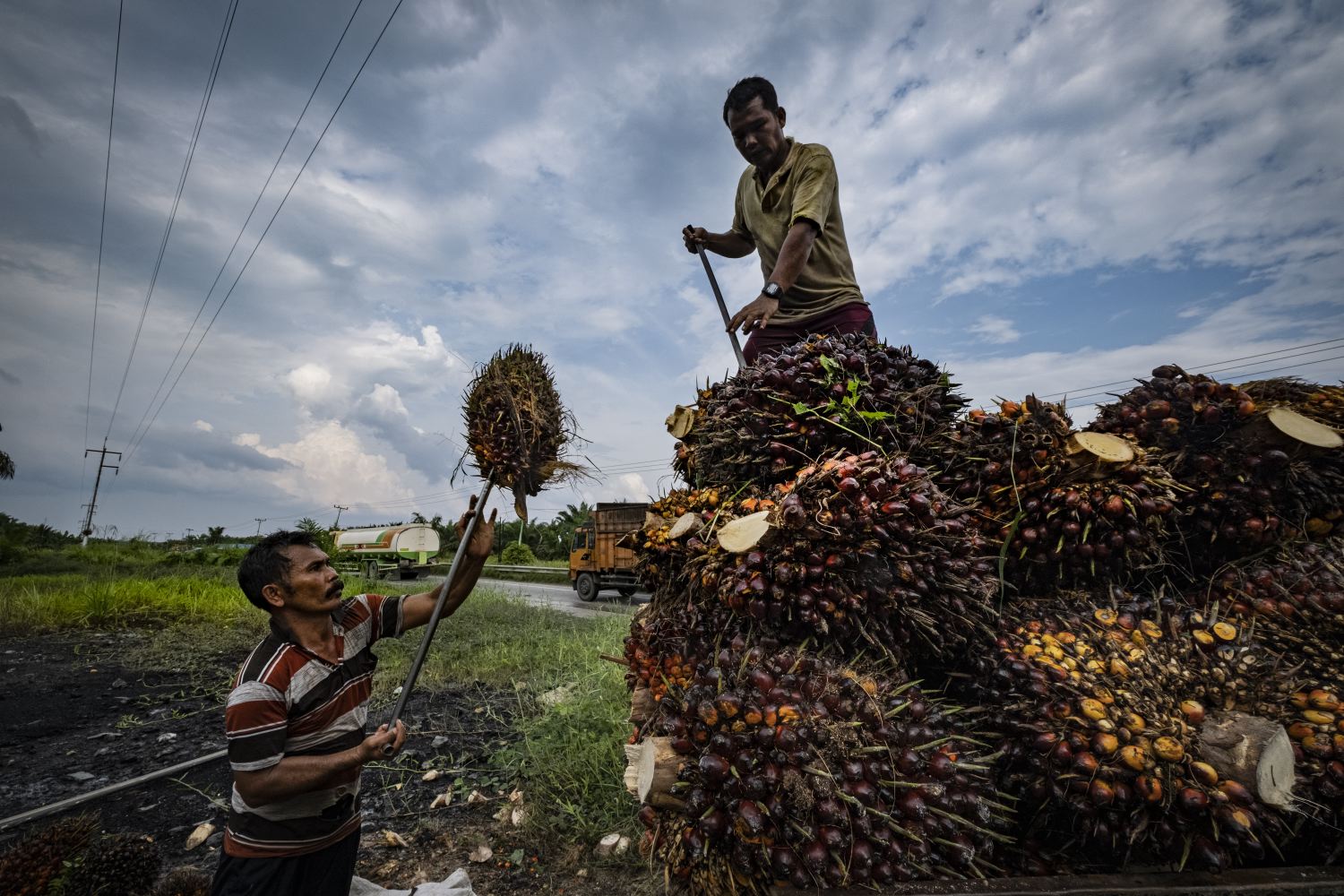
 Two men load palm oil fruits onto a truck in Riau province, Sumatra.
Oil palm-driven deforestation has slowed since 2015: what role did zero-deforestation commitments play ?
Two men load palm oil fruits onto a truck in Riau province, Sumatra.
Under pressure from consumers and NGOs and concerned about reputational risk, the world’s largest producers, traders, and buyers of palm oil (and its derivatives) adopted zero-deforestation commitments, often through No Deforestation, No Peat, No Exploitation (NDPE) policies.
These companies voluntarily set reference dates, such as December 2015, after which oil palm grown on newly deforested land would no longer be accepted into their supply chains. More recently, the EU Deforestation Regulation (EUDR) requires companies placing palm oil on the EU market to demonstrate that their products are not linked to deforestation occurring after 31 December 2020.
But has deforestation declined since these commitments were adopted?
In our new preprint, which has not yet undergone peer review, we sought to answer this question.
First, we identified all areas worldwide planted with monoculture oil palm, using satellites and a method that combines deep learning classification and expert visual interpretation. Next, we mapped where oil palm plantations directly replaced old-growth evergreen rainforest across the tropics each year between 2001 and 2024.
We identified oil palm plantations in 47 tropical countries and mapped a total of 30.17 million hectares (Mha), 65.8% industrial and 34.2% smallholder. After correcting for classification errors, the adjusted oil palm extent was 29.86 Mha (95% confidence interval: 29.17–30.55 Mha).
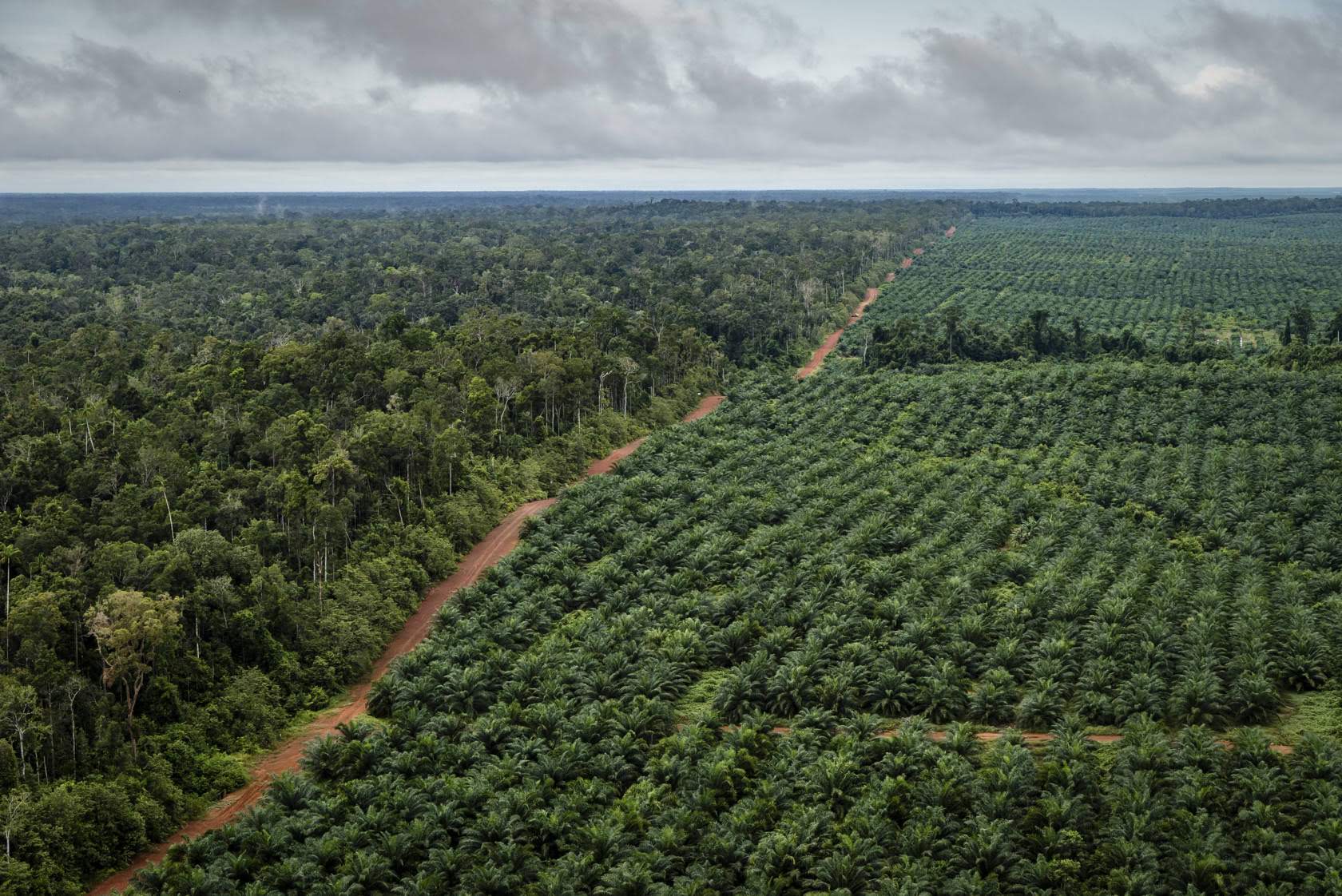
We found that, between 2001 and 2024, oil palm plantations replaced 5.86 Mha (95% CI: 5.60, 6.11) of old-growth evergreen rainforest across these 47 countries, or 7.5% of the total mapped loss of rainforest.
About 73% of this conversion was associated with industrial plantations, while 88% occurred in Sumatra, Borneo and Peninsular Malaysia, the historical heartland of modern palm oil production, with Indonesia and Malaysia by far the world’s largest producers.
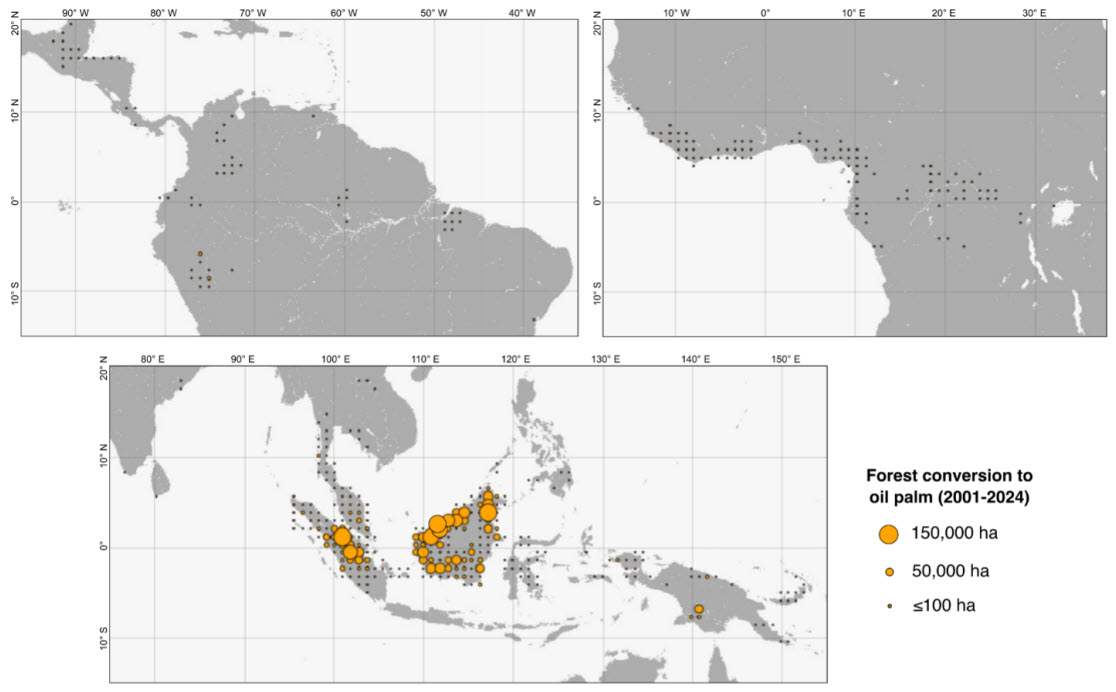
Americas (top left), West and Central Africa (top right), and Southeast Asia (bottom). Circles show the forest conversion to oil palm within grid cells of 100 x 100 km. Source: Descals et al. (preprint).
Importantly, our results show a decline in forest conversion to oil palm after 2015. During 2001–2015, 343,000 hectares of forest were converted to oil palm every year. During 2016–2024, this fell to 80,000 hectares per year.
This conversion also became a smaller share of tropical rainforest loss after 2015. Conversion to oil palm accounted for 12.2% of total forest loss before 2015, compared with 2.2% after 2015.
Did NDPE commitments cause the decline?
A recent study published in PNAS examined zero-deforestation commitments within Indonesian oil palm concessions between 2018 and 2020. The study found that concessions linked to companies with zero-deforestation commitments had very low deforestation, and that deforestation declined by similar amounts in concessions not covered by the commitments. The authors concluded that there is no additionality from corporate zero-deforestation commitments, a finding subsequently reported by Mongabay.
But does similar performance between concessions with and without commitments necessarily mean that the commitments made no difference? As Dutch conservationist Erik Meijaard asks, a co-author of our preprint: could zero-deforestation commitments have helped shift norms and practices across the wider palm oil sector, including among companies that never formally adopted such commitments?
Rather than comparing individual concessions over a short period, our new study examines global patterns of oil palm expansion and associated forest conversion over more than two decades, allowing us to compare the periods before and after zero-deforestation commitments became widespread.
One striking finding is that the decline in palm oil-driven deforestation persisted despite a strong recovery in palm oil prices, which our earlier research in Indonesia showed to be closely associated with oil palm expansion and forest loss: a 1% annual increase in crude palm oil prices was associated with a 1.08% increase in new industrial plantation expansion and a 0.68% increase in forest loss during 2001–2019. Yet, forest conversion to oil palm continued to slow after 2019 even when palm oil prices rose sharply, from around USD 600 per tonne in 2015 to levels approaching USD 1,500 per tonne in recent years. High prices no longer appear to accelerate forest clearing for new plantations to the same extent as they did in the past, perhaps the strongest indicator that zero-deforestation commitments contributed to the decline. Other factors likely played a role, including the declining availability of suitable land for new plantations, domestic forest-protection policies, and the growing need to replant ageing plantations rather than expand into new areas.
What is clear is that the palm oil sector today looks different from that of the 2000s. We know from the field that new plantations are now less likely to directly replace forest because major traders and buyers increasingly scrutinise deforestation in their supply chains and face strong reputational and commercial risks when sourcing from recently deforested land.
Progress, but not the end of oil palm-driven deforestation.
Whatever the reasons behind the decline, our findings show that progress has been made in reducing oil palm-driven deforestation. But this has not disappeared. Around 80,000 hectares of old-growth forest were still converted to oil palm each year during 2016–2024. In Papua, the new frontier, it doubled in 2025 compared with the previous year, and it continues to threaten some protected areas, such Rawa Singkil Wildlife Reserve in Sumatra, home to a large population of orangutans.
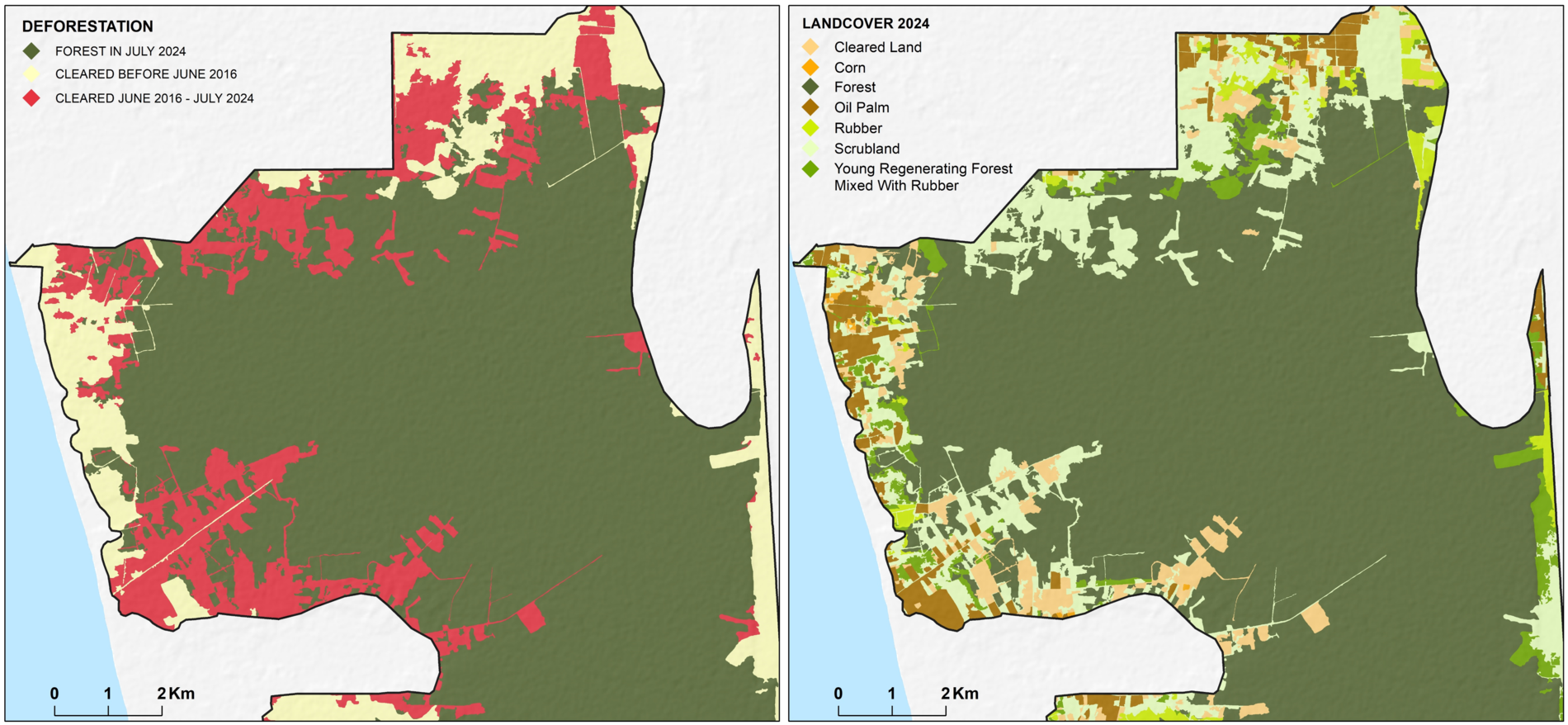
In addition, reduced deforestation today does not erase the environmental legacy of earlier plantation expansion at the expense of peat-swamp forests in Indonesia. Large areas of oil palm in Sumatra and Kalimantan were established on peatlands that were cleared and drained over the last 50 years. Once dry, this carbon-rich peat soil becomes highly vulnerable to fire.
The consequences of this past deforestation are still being felt today. By the end of August, 900,000 hectares had already burned during Indonesia’s 2026 fire season, with the most severe fires occurring on previously deforested and drained peatlands, including within RSPO-certified concessions. RSPO is a certification system intended to promote sustainable palm oil production. When drained tropical peat burns, it produces dense toxic smoke and releases large quantities of greenhouse gases.
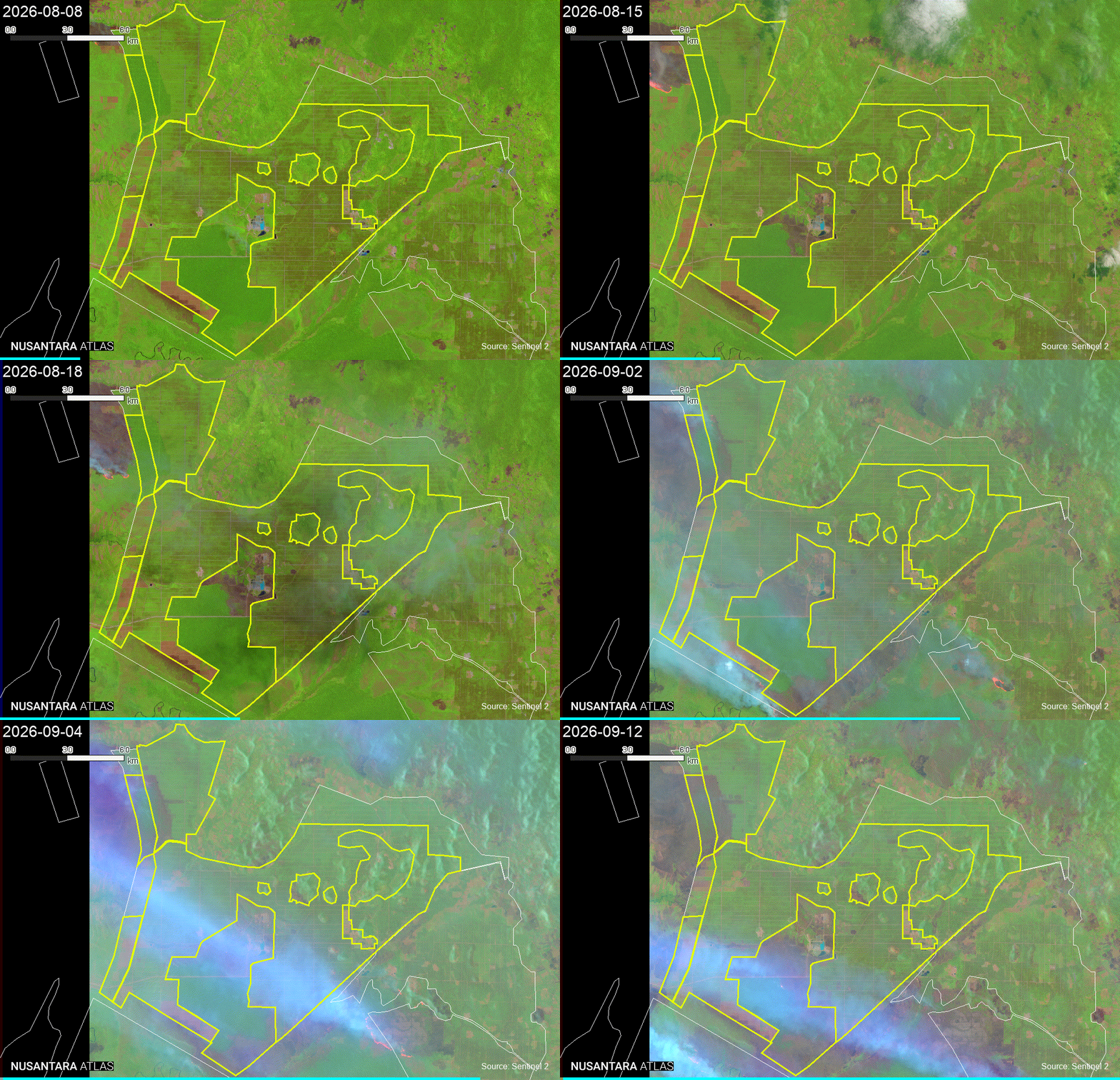
Therefore, while today’s palm oil industry may no longer be associated with the same level of deforestation as it was in the 2000s, some growers continue to clear forests, and parts of the industry still operate on drained peatlands that carry the long-term consequences of past deforestation, including recurrent fires that generate severe air pollution, harm human health and release large quantities of greenhouse gases.
Preventing new deforestation is therefore only one part of the challenge. Protecting remaining peatlands, restoring degraded peat hydrology and stopping recurrent fires are equally important. Continued monitoring is also essential, as forest conversion for oil palm has declined but has not disappeared.
The study “Global oil palm deforestation declines after zero-deforestation commitments” by Adrià Descals, Mohammad Agus Salim, Husna Yaen, Reji Gunawan, Fadiya Salsabila, Douglas Sheil, Erik Meijaard and David Gaveau is currently available as a preprint and has not yet undergone peer review.